
Third-party commercial solar gives you a “second pair of eyes.” By partnering with a dedicated O&M specialist like Solar Medix, businesses gain access to advanced diagnostic technology and a team whose primary focus is system health. They don’t have a bias toward the original builder. So, they’ll tell you exactly what’s happening.
This independent oversight ensures that your energy production remains consistent, your equipment stays within safety compliance, and your internal teams are freed up to focus on your core business operations.
Buying solar panels for your business is a smart move to save money, but you can’t just “set it and forget it. The initial installation is only the beginning of the journey. Your solar system needs more than just a quick wash to keep running for 25 years. So, businesses must look beyond the original solar installer and consider the specialized expertise of third-party servicing.
Third-party providers offer an unbiased, technical perspective that focuses solely on performance longevity rather than just meeting the bare minimum of a construction warranty.
Many owners assume that if the panels are on the roof, they are working perfectly. In reality, they are constantly exposed to harsh environmental stressors like weather and dust, electrical degradation, and potential component failures, which can slowly reduce your energy savings.
According to a technical report by NREL, O&M could improve the average performance ratio of systems from 91.7 to at least 95%. So, regular maintenance is the only way to make sure you actually get the financial return you were promised. Without a dedicated servicing partner, minor issues can quickly snowball into significant revenue losses.
What Is Third-Party Commercial Solar Servicing?
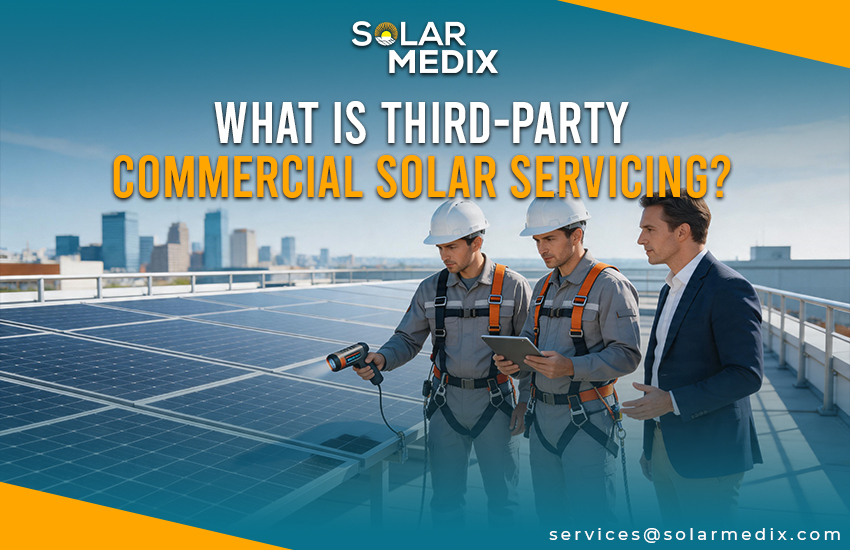
Third-party commercial solar servicing is a comprehensive suite of operations and maintenance (O&M) solutions provided by a specialized firm that didn’t necessarily install your system. This service is designed to bridge the gap between simple electrical checkups and full-scale asset management. While an installer’s main goal is to get the panels up and running quickly, a third-party servicer’s job is to make sure they stay functioning at 100% for decades.
A professional servicing partner will inspect every component of the array, from the glass modules to the complex inverter internals and racking systems. They maintain the system through cleaning and preventative adjustments, repair localized failures before they lead to system-wide outages, and optimize the energy output using data-driven insights. This holistic approach ensures that the system doesn’t just function, but excels in its specific environment.
Limitations of Relying Only on Basic Maintenance or In-House Teams
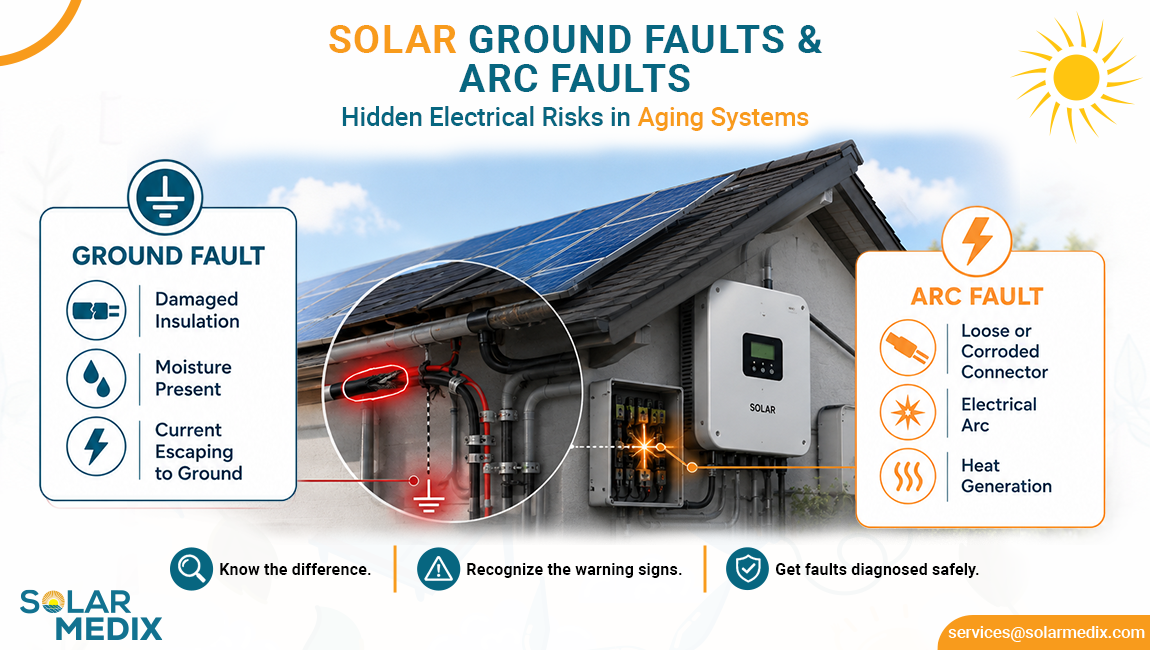
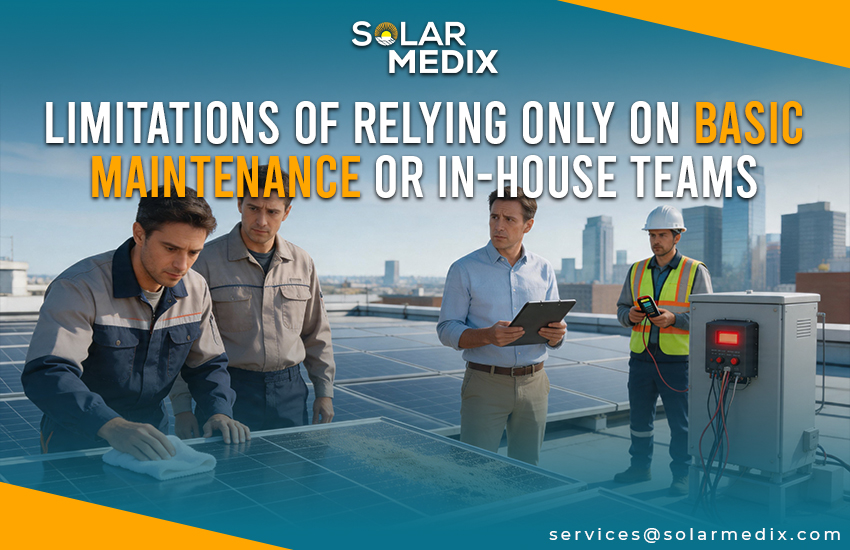
Many organizations attempt to manage their solar assets using a general in-house maintenance crew or standard/local electricians. However, these teams often lack specialized solar expertise. Solar PV systems involve high-voltage DC electricity and complex power electronics. It requires specific training beyond general commercial electrical work. Without this deep knowledge, in-house teams may overlook subtle signs of degradation or incorrectly diagnose power fluctuations.
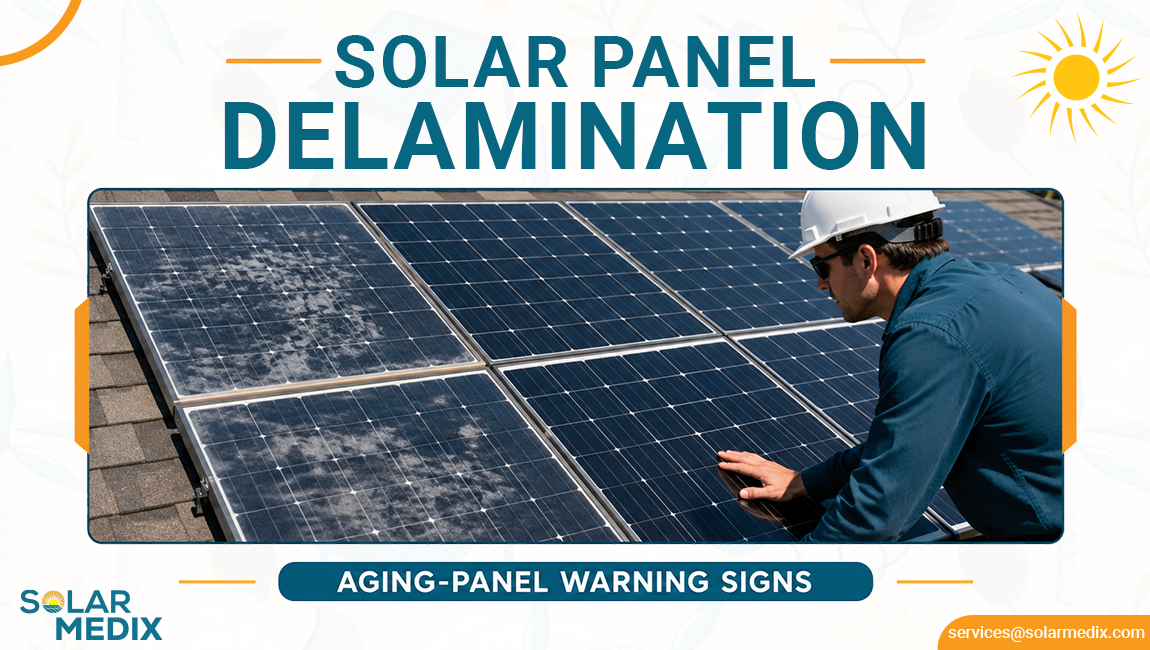
General maintenance teams usually have no advanced diagnostic tools, such as thermal imaging drones or IV curve tracers, which are essential for identifying “invisible” problems like cell micro-cracks or PID (Potential Induced Degradation). This often leads to a reactive instead of proactive maintenance cycle, where issues are only addressed after the system has already failed. Consequently, businesses suffer from missed performance issues that quietly drain ROI for months before being noticed.
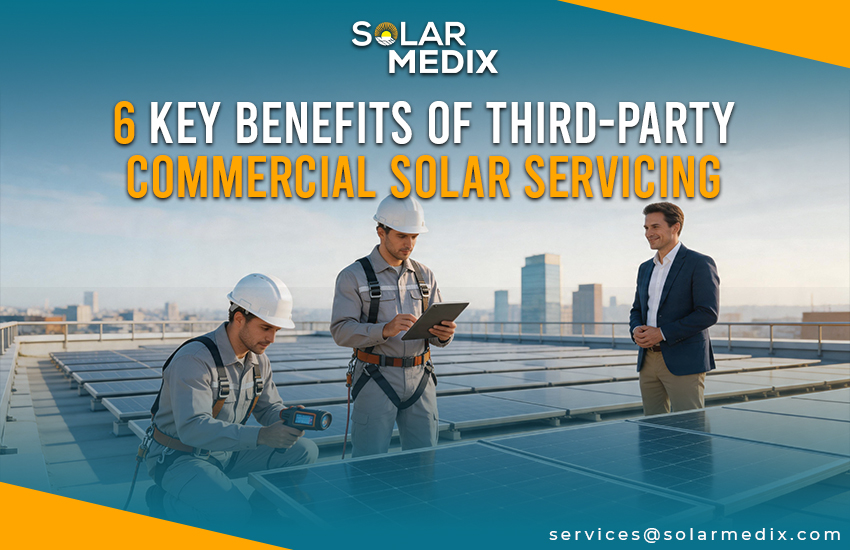
6 Key Benefits of Third-Party Commercial Solar Servicing
A dedicated specialist treats your solar asset as a financial investment rather than just another piece of rooftop equipment. Here are the six primary advantages:
Benefit #1: Independent Performance Evaluation
An independent servicer provides an unbiased look at how your system is actually performing compared to the original projections. Unlike installers who may be hesitant to point out flaws of their own equipment, a third-party firm prioritizes transparency.
- Validation of actual vs. modeled energy yields.
- Unbiased reporting for stakeholders and investors.
- Identification of installation-related defects that need warranty claims.
Benefit #2: Advanced Diagnostics and Monitoring
Third-party specialists utilize high-end technology to see what the naked eye cannot. This data-heavy approach allows for precision targeting of maintenance needs.
- Aerial thermography to detect hotspots and failing modules.
- Detailed IV curve testing to measure string health.
- 24/7 remote monitoring with real-time error alerts.
Benefit #3: Cost Efficiency
This type of servicing has an upfront cost. However, it significantly reduces the Total Cost of Ownership (TCO). By preventing major inverter failures or fire hazards, you save thousands in emergency repairs.
- Reduced insurance premiums through documented safety inspections.
- Prevention of “cascading failures” in electrical components.
- Maximizing energy credits and utility savings through peak performance.
Benefit #4: Faster Response and Support
Dedicated O&M firms have streamlined workflows asd well as specialized crews ready to deploy. You won’t be stuck at the bottom of a busy installer’s “to-do” list during the peak of their construction season.
- Guaranteed response times for critical system outages.
- Ready access to specialized spare parts and components.
- Expertise in navigating complex manufacturer warranty processes.
Benefit #5: Proactive Maintenance Approach
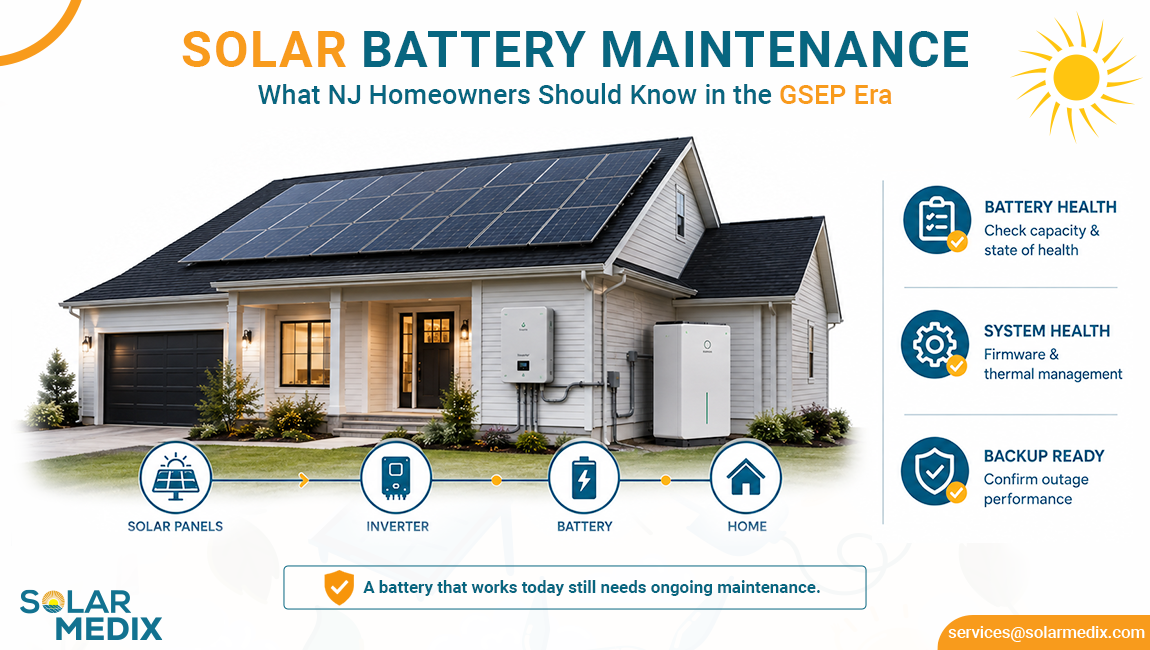
The shift from reactive to proactive maintenance is the hallmark of professional servicing. Scheduled visits ensure that small issues, like loose connections or debris buildup, never become big problems.
- Scheduled tightening of racking and electrical connections.
- Regular debris removal and panel cleaning to prevent shading.
- Early detection of wear and tear on wiring insulation.
Benefit #6: Support for Orphan Solar Systems
Many businesses become a solar orphan when their original installer goes out of business or pivots away from servicing. Third-party providers step in to manage these systems without a lapse in coverage.
- Continuity of care for systems with no active installer support.
- Historical data reconstruction for better performance tracking.
- Expertise across multiple hardware brands and system types.
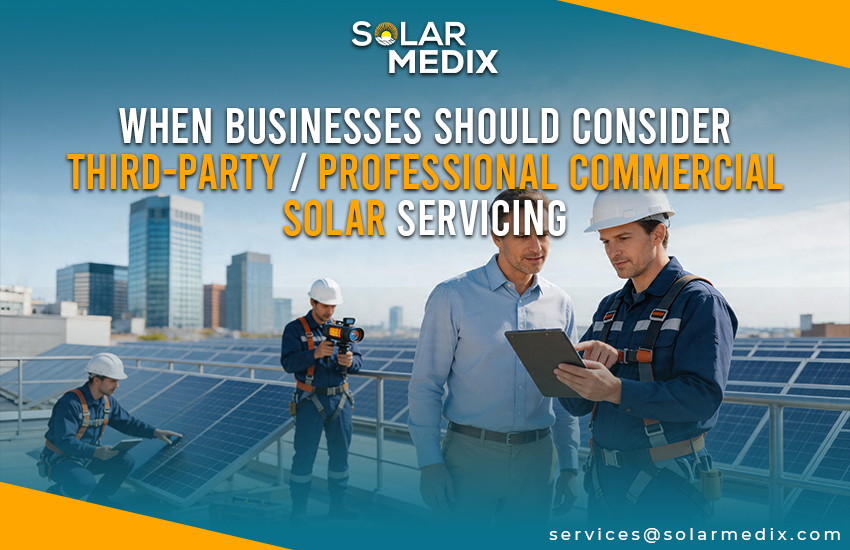
When Businesses Should Consider Third-Party / Professional Commercial Solar Servicing
Timing is everything when it comes to preserving your solar investment. It is often more cost-effective to onboard a servicing partner before solar system failures.
If your business is experiencing any of the following, it is time to seek professional intervention:
- Immediately after the initial installer’s O&M contract ends.
- When you notice declining system performance or higher-than-expected utility bills.
- If your team lacks monitoring visibility and doesn’t understand the data being reported.
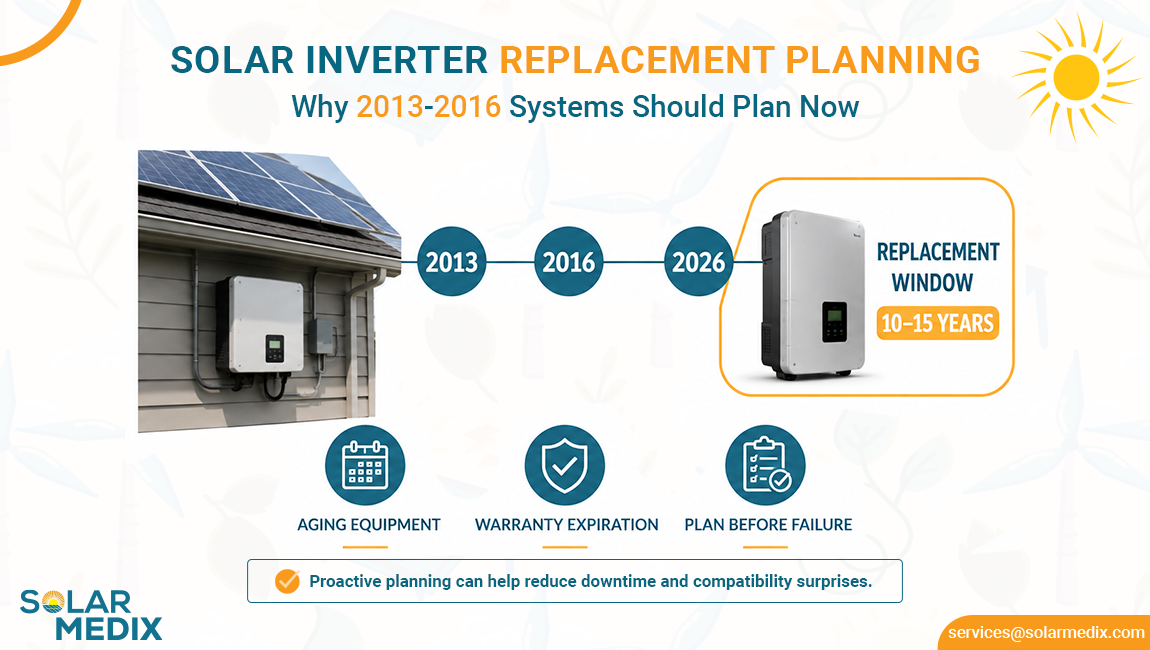
- As the system enters its “middle age” (5–10 years), component aging becomes a factor.
- When you realize your current maintenance strategy is strictly reactive.
- Upon the acquisition of a new commercial property with an existing solar array.

Protect Your Solar Investment with Third-Party Commercial Solar Servicing
The long-term success of your clean energy transition depends on the reliability of your hardware. Solar Medix specializes in the high-level care and technical precision required to keep commercial systems running at maximum capacity. We don’t just fix problems; we enhance your asset’s value with our comprehensive commercial solar services.
By choosing an independent partner, you ensure that your solar array remains a high-performing asset for decades to come. So, don’t wait for a system failure to realize the importance of expert maintenance. Contact us today to secure your system’s future.
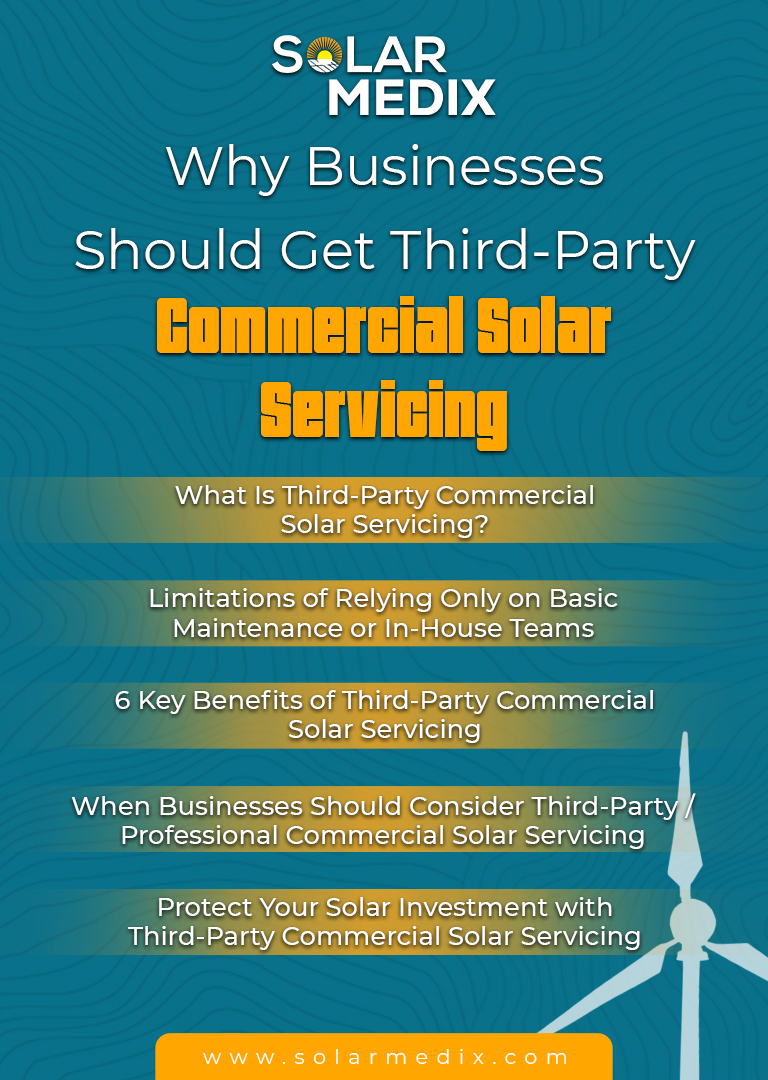
Frequently Asked Questions
How does third-party solar work?
Third-party solar, often called Third-Party Ownership or TPO, allows homeowners to install solar panels with little to no upfront costs, as a separate company owns, maintains, and installs the equipment. The homeowner hosts the panels and either rents them (lease) or buys the generated power at a lower rate (PPA), typically saving on electricity costs over a 10-25 year contract.
What is third-party energy?
Third-party energy refers to electricity supplied by an independent company rather than the local utility, which is common in deregulated markets.
Why do companies use third parties?
To increase efficiency, reduce costs, and access specialized expertise.
Why should I hire a third party instead of my original installer?
Third-party providers offer an unbiased evaluation of your system’s health. Installers are often focused on new builds and may overlook minor defects to avoid warranty claims. A dedicated O&M (Operations & Maintenance) specialist like Solar Medix prioritizes performance and long-term efficiency above all else.