Yes, a home battery needs ongoing maintenance in New Jersey’s GSEP era, including checks of battery health, capacity, firmware, thermal management, settings, and backup performance. As more New Jersey homes add battery storage, confirming that the battery is actually being maintained is important for reliability, capacity, and outage readiness.
Home batteries often receive plenty of attention when they are installed but little afterward. Solar battery maintenance can be easy to overlook because a battery may continue operating without obvious signs that it needs attention. As battery adoption grows across New Jersey, regular checks become more important. This guide covers what solar-plus-storage O&M involves, how battery maintenance differs from panel maintenance, and how to determine whether a battery is ready to provide backup power during an outage.
Why Solar Battery Maintenance Matters
Solar battery maintenance matters because regular checks help protect battery performance, identify developing problems, and extend the useful life of the system. Batteries constantly charge and discharge while managing internal temperature, so their condition can change over time. Regular attention to battery health, temperature, settings, connections, and performance can help catch issues before they lead to reduced storage capacity, unexpected shutdowns, or more expensive repairs. For homeowners considering solar battery storage for their home, maintenance should be treated as part of keeping the system reliable, not something to think about only when a problem appears.
What Solar Plus Storage O&M Actually Covers
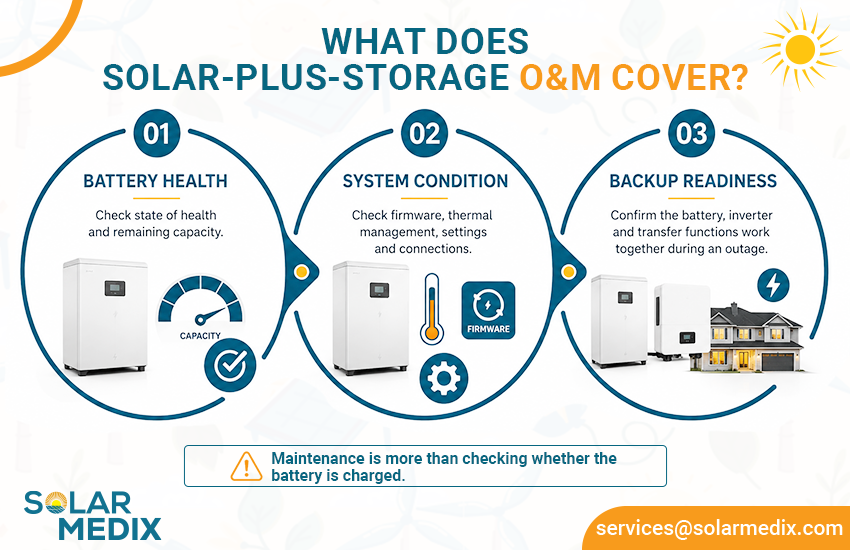
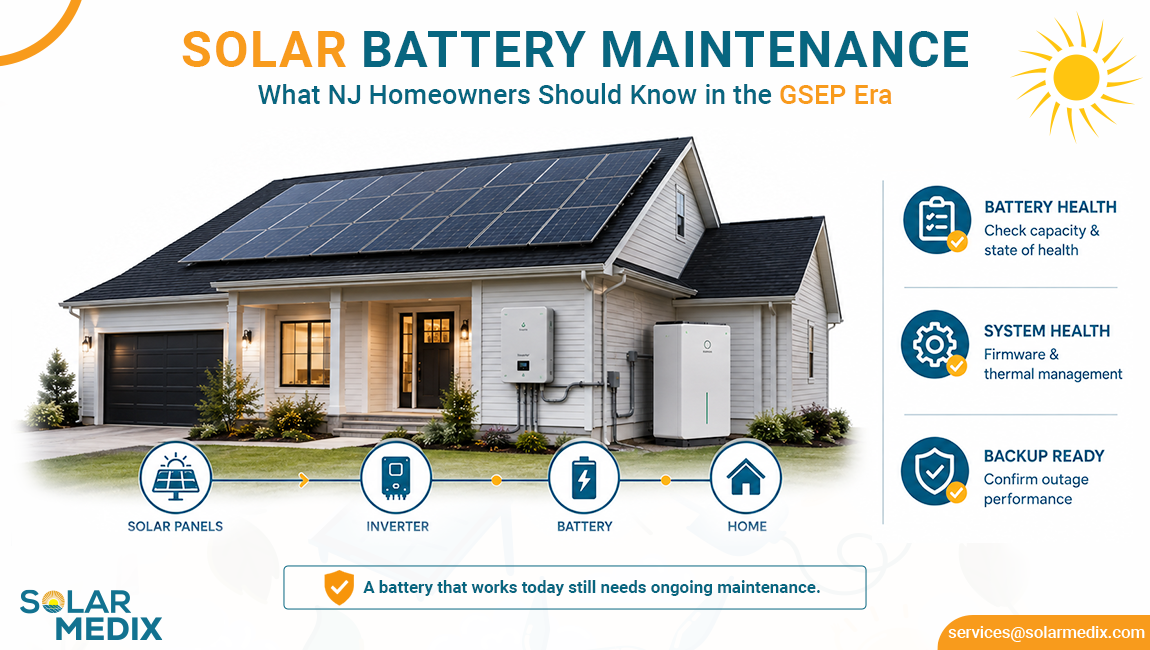
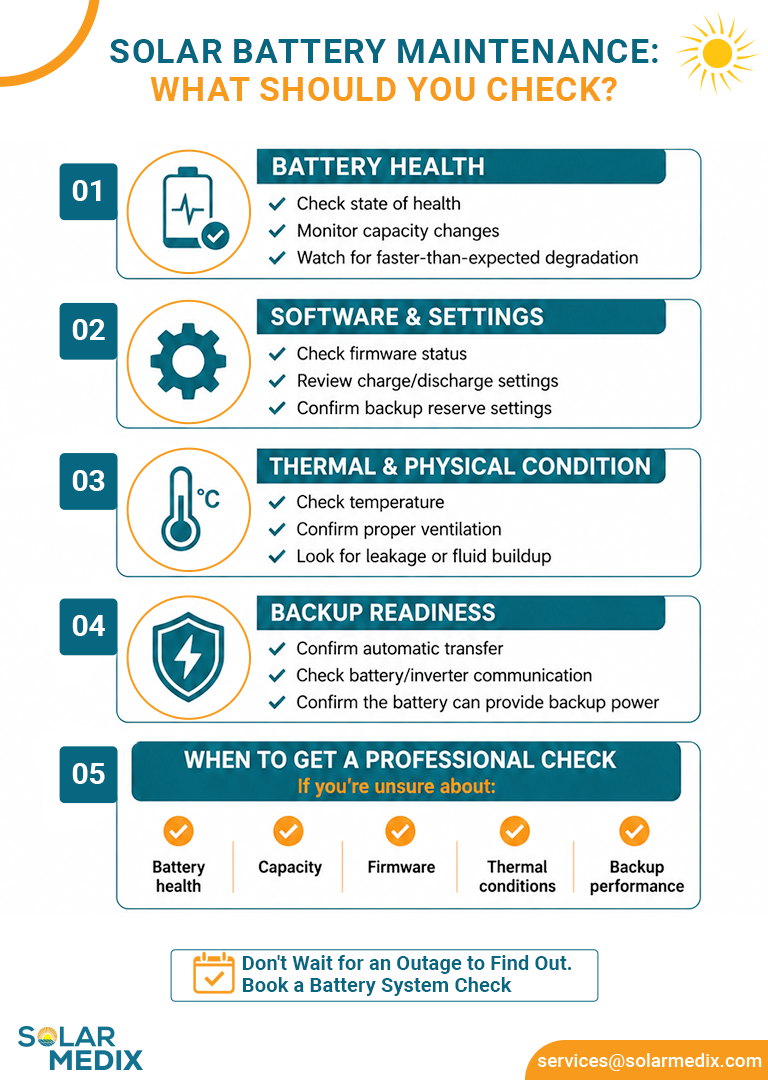
Solar plus storage O&M breaks down into three practical areas: how well the battery is holding its charge, how well it’s being kept in safe operating condition, and whether it’s actually ready to do its job during an outage.
Checking Battery State of Health and Capacity
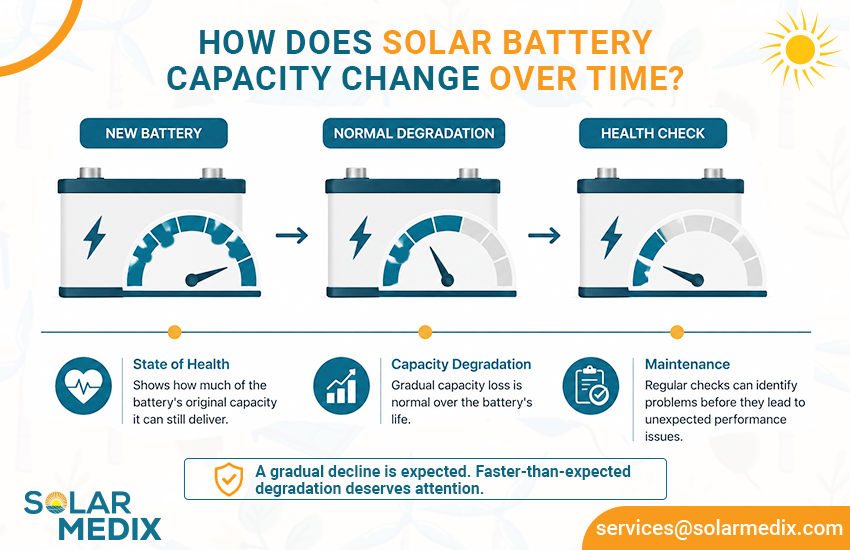
State of health is a battery’s way of reporting how much of its original capacity it can still deliver, and it declines gradually over the life of the system. Battery capacity degradation in a solar-plus-storage setup is normal and expected, but the rate of that decline depends heavily on how the battery has been used and maintained. A periodic check of the state of health catches a battery that’s degrading faster than it should, while there’s still time to address the cause.
Firmware Updates and Thermal Management
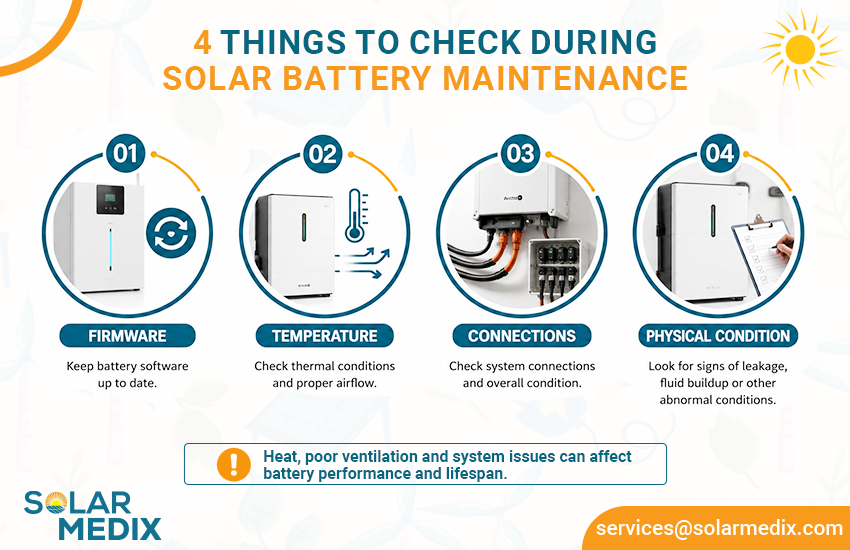
Battery firmware updates matter more than most owners realize, since they often improve charge management and safety behavior well after installation. Thermal management is just as important: NREL’s guidance on residential battery lifespan recommends installing batteries in a cool, dry location with proper spacing for airflow, since sustained heat is one of the biggest drivers of shortened battery life, and recommends regular inspection for leakage, fluid buildup, and uneven voltage as part of routine upkeep.
Backup Readiness and Inverter Integration
A battery that holds a full charge on paper isn’t necessarily one that will deliver power correctly during an outage. Backup readiness testing confirms the automatic transfer function, reserve settings, and inverter battery integration are all actually working together, not just that the battery itself is charged. This is especially relevant for homes relying on storage for resilience, where the battery needs to perform reliably when needed. Off-grid home solar systems depend heavily on battery performance, making regular maintenance and testing even more important.
How Long Do Solar Batteries Last, and Does Maintenance Help?
Most home batteries last around 10 years, and regular maintenance can help them stay reliable and perform well throughout that period.
Home batteries gradually lose capacity over time, but proper ventilation, correct charge and discharge settings, and up-to-date firmware can help reduce avoidable wear. A home battery storage service can identify issues such as poor thermal management, system faults, or configuration problems before they affect performance. The difference between a battery that’s still performing well in year nine and one that needed early replacement often comes down to whether anyone was checking on it in between.
New Jersey’s Push Toward Battery Storage
New Jersey’s Garden State Energy Storage Program (GSEP), approved by the NJBPU in 2025, set a mandate to deploy 2,000 megawatts of energy storage statewide by 2030, and it reflects just how aggressively the state is now pushing battery adoption. That push is already translating into more batteries showing up paired with residential solar every year, and it’s exactly this kind of rapid growth that creates a service gap: adoption is accelerating faster than the maintenance conversation around it. Most owners who added storage in the past year or two have heard plenty about incentives and backup power, and very little about what keeps that battery performing once it’s installed.
How Do I Know My Battery Will Work During an Outage?
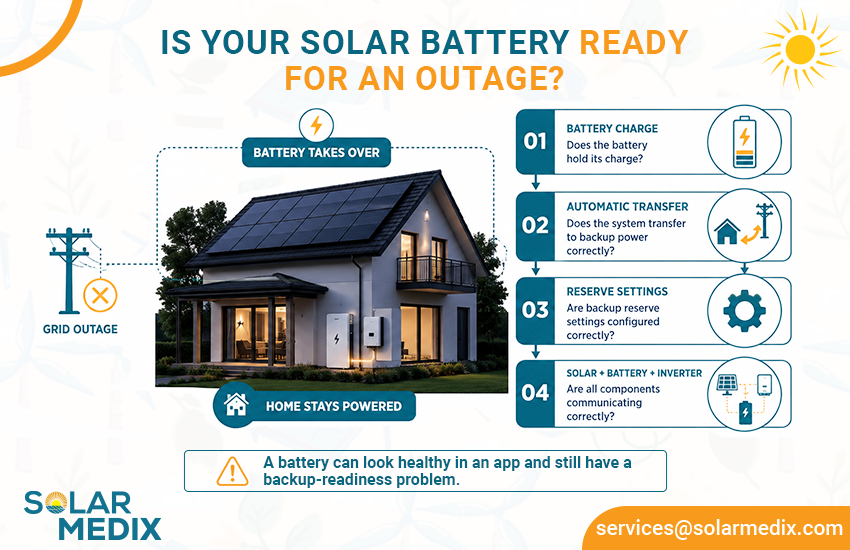
The only reliable way to know is a backup-readiness check, since a battery can appear healthy on a monitoring app and still fail to deliver power correctly when the grid actually goes down. That check confirms the battery holds charge, the automatic transfer functions as designed, reserve settings are configured correctly, and the solar-battery-inverter communication is intact. Many owners discover a gap in one of these only during an actual outage, which is exactly the wrong time to find out. A ten-minute readiness check ahead of storm season or a stretch of severe weather is a far better time to catch a misconfigured transfer switch than the middle of a multi-day outage.
Find Out What Your Battery System Actually Covers
A battery that’s never been checked isn’t necessarily a problem, but it’s an unknown, and an outage is a bad time to discover the answer. Solar Medix works with solar-plus-storage systems on the equipment and integration side: state-of-health checks, firmware status, thermal conditions, and backup readiness, alongside the solar maintenance many owners already have in place. Battery brands and configurations vary, so if you’re not sure what’s covered for your specific setup, the simplest next step is to ask us to confirm the scope before your next scheduled visit.
Solar Battery Maintenance FAQs
Do home solar batteries need maintenance?
Yes. Batteries are the most active component in a solar-plus-storage system and degrade with use and temperature. Maintenance covers checking state-of-health and capacity, applying firmware updates, verifying thermal management and ventilation, and confirming the battery will actually deliver backup power when the grid goes down.
How long do solar batteries last, and does maintenance help?
Most home batteries are warranted for around 10 years and lose capacity gradually over time. Proper conditions, good ventilation, correct settings, and up-to-date firmware help them hit their expected lifespan, while poor thermal management or misconfiguration can shorten it.
How do I know my battery will work during an outage?
The only reliable way is a backup-readiness check: confirming the battery holds charge, the automatic transfer functions, reserve settings are correct, and the solar-battery integration is communicating. Many owners discover a problem only during an outage, which is exactly when you don’t want to.
Does New Jersey offer incentives for home batteries?
New Jersey introduced the Garden State Energy Storage Program (GSEP) to support residential battery storage, which has increased adoption. That growth is exactly why storage maintenance is becoming important: more batteries in service means more that need periodic checks.
Can Solar Medix service my solar battery system?
Solar Medix works with solar-plus-storage systems and their integration with the inverter and monitoring. If you’re unsure what’s covered for your specific battery brand, ask us before booking so we can confirm the scope for your equipment.