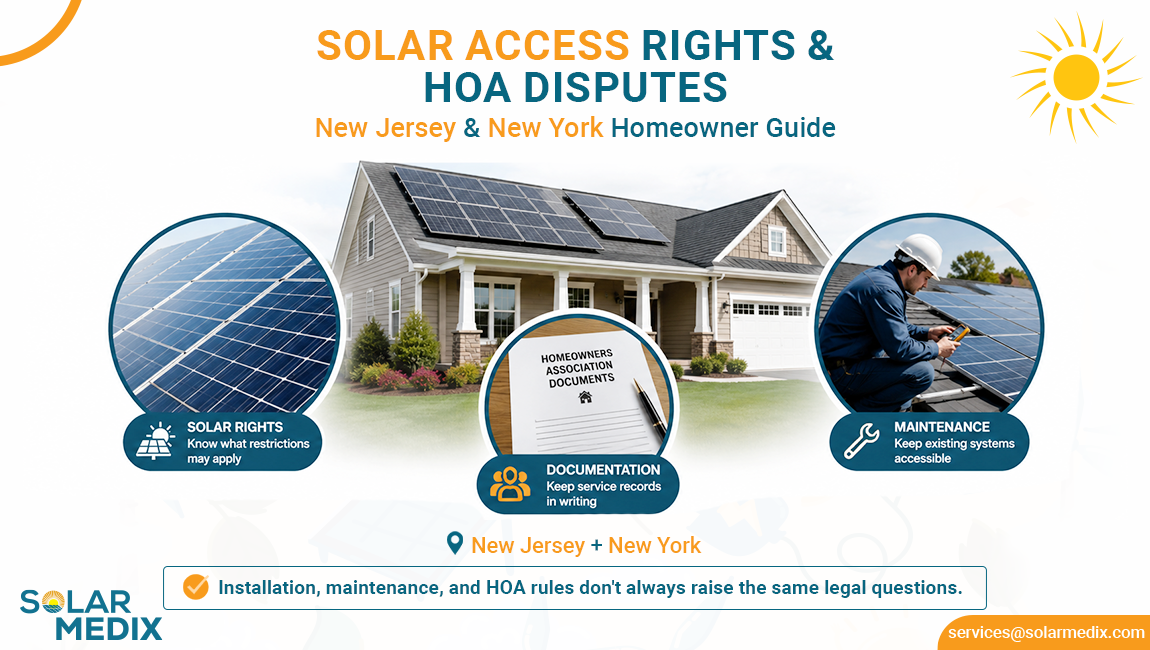
Solar access rights in New Jersey and New York generally prevent HOAs from banning residential solar or imposing unreasonable restrictions, while still allowing reasonable rules on placement, appearance, and system design.
New Jersey’s Solar Rights Act also requires associations to adopt a written solar policy as of April 2026, while New York provides similar protections in many HOA communities. However, condos and co-ops can be more complicated because roofs may be shared property. This guide covers HOA restrictions on solar installation, maintenance, and repairs, including disputes that may trace back to what was agreed at the contract stage.
Solar Access Rights in New Jersey and New York: The Legal Basics
HOAs in New Jersey and New York generally cannot impose unreasonable restrictions that effectively prevent homeowners from installing, using, maintaining, or repairing their solar systems. The exact protections and limits vary by state, but an HOA’s rules still need to leave reasonable access to the system while addressing legitimate concerns such as safety, roof work, and property maintenance.
New Jersey’s Solar Rights Act
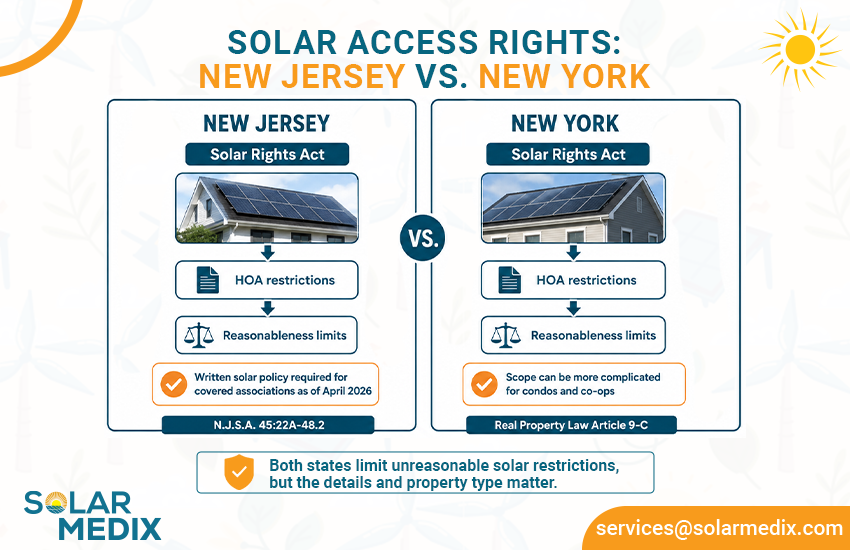
New Jersey’s protection comes from the Solar Rights Act, N.J.S.A. 45:22A-48.2, which voids any HOA bylaw, covenant, or master deed provision that effectively prohibits solar on an individually owned home or unit. Associations can still require reasonable placement or aesthetic standards, but those restrictions generally can’t increase installation or maintenance costs by more than roughly 10 percent or meaningfully cut into how much power the system produces. As of April 1, 2026, New Jersey went a step further and now requires condominium and subdivision associations to adopt a written policy spelling out members’ solar rights, which gives homeowners something concrete to point to if a board tries to improvise a rule on the spot.
New York’s Solar Rights Act
New York’s version, added to the Real Property Law as Article 9-C, similarly voids HOA restrictions that effectively prohibit or unreasonably limit a solar power system, using a comparable standard: a restriction generally isn’t reasonable if it increases cost by more than 10 percent or keeps the system from operating at maximum efficiency. Where New York’s law gets murkier is scope. It was written with HOA-governed detached and townhome communities in mind, and it doesn’t clearly extend to condominiums or co-ops, where the roof is typically a common element owned by the association rather than the individual unit.
Can an HOA Deny Solar Maintenance or Repairs?
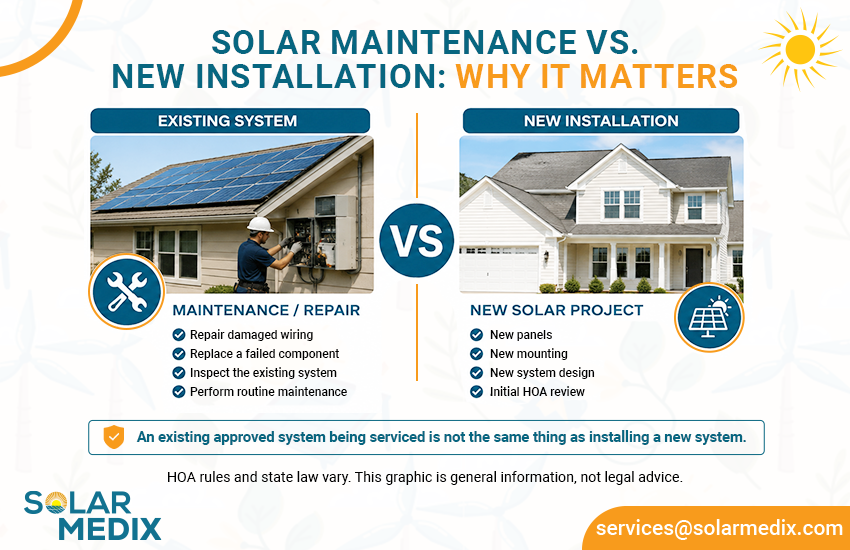
No, not outright. Both states’ solar statutes were written primarily around the installation decision: can an HOA say no to putting panels up in the first place. Neither law spells out roof access maintenance with the same specificity it gives new installs. That said, the same reasonableness standard is the best available guide: an association that approved a system and now blocks the routine maintenance, repair, or replacement needed to keep it functioning is on shaky ground under the same logic that prohibits an outright installation ban. A board willing to work with an owner on scheduling and access is closer to what solar rights law actually expects, something like a reasonable accommodation for solar rather than a blanket veto. If your HOA is treating a repair visit as a brand-new installation requiring fresh approval, that’s worth pushing back on directly.
What Should You Do If Your HOA Pushes Back?
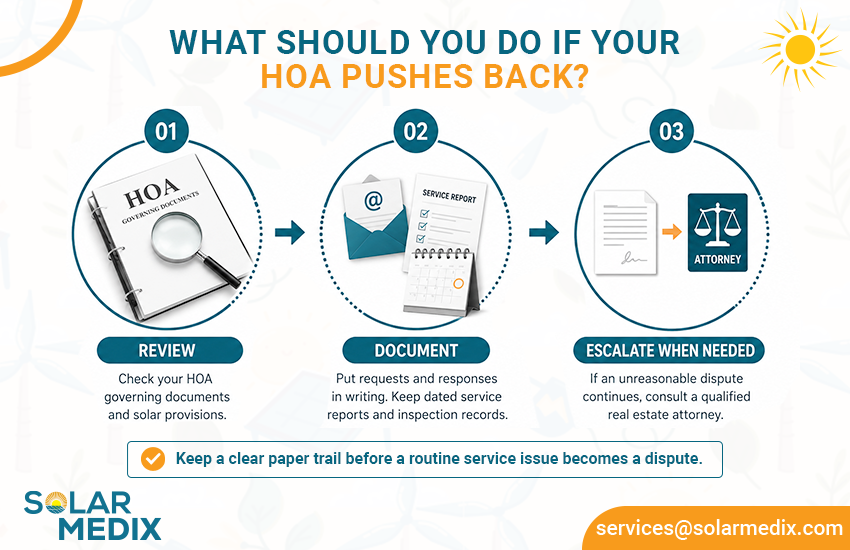
Most HOA solar panel disputes start exactly this way: a board treating routine work as something new, or an owner unsure whether they even need to ask. Two things matter most once that happens: building a paper trail, and knowing when to escalate.
Document Everything in Writing
Start by reviewing your HOA’s governing documents and any solar-specific provisions, and put every request and response in writing rather than relying on a verbal conversation at a board meeting. Frame the request clearly as maintenance or repair of an existing, previously approved system, not a new installation, since that’s exactly where the reasonableness standard applies most cleanly. A dated, written service report, similar to what you’d expect from understanding your solar energy contract in the first place, adds documentation that’s hard for a board to dispute later.
Know When to Involve an Attorney
If a written request gets an unreasonable denial, a demand for a new approval process, or no response at all, that’s the point to consult a real estate attorney rather than negotiate informally. New York’s law specifically includes a private right of action allowing a homeowner to sue an HOA that violates it, and an attorney familiar with your statute and your association’s documents can tell you quickly whether a restriction is likely to hold up.
Condos, Co-ops, and Shared Roofs: Where the Rules Get Murkier
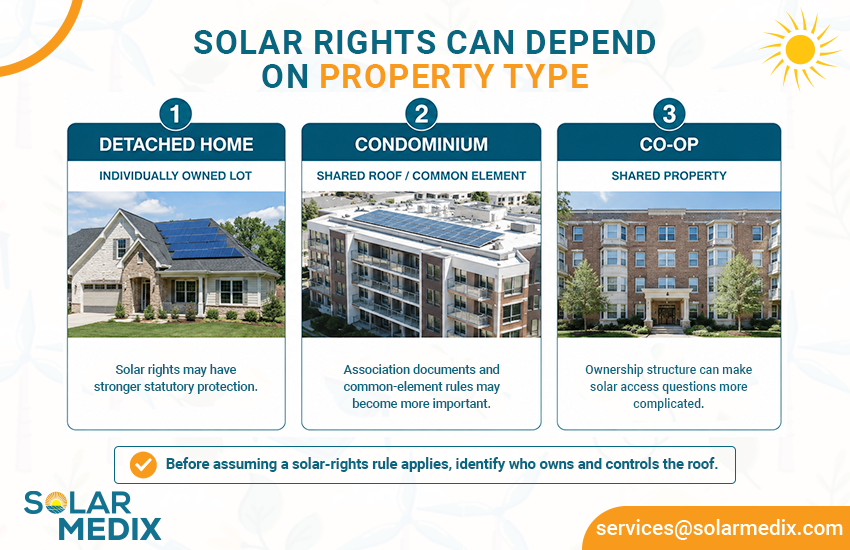
Both states’ protections are strongest for individually owned lots and units, and weaker once the roof becomes shared property. In a condominium or co-op, the roof is typically a common element controlled by the association, so condo solar rules often default back to the association’s own governing documents rather than a strong state-law override. A formally recorded solar easement, where a state allows one, is a separate legal tool entirely, typically used to protect sunlight access from a neighboring structure rather than settle a maintenance disagreement with your own association. Municipal solar ordinances add another layer on top of HOA rules, covering permitting and placement independent of what an association allows.
If you’re in a condo or co-op, understanding your association’s own policy matters even more than for a detached home, and staying current on routine solar operations and maintenance gives you a documented track record if the roof’s shared status ever becomes part of a dispute.
Keep Your System Documented, Serviced, and Compliant
Most HOA solar disputes come down to documentation: whether there’s a clear, dated record showing the work was maintenance on an approved system rather than something new. Solar Medix keeps that record for you, with service reports, inspection findings, and production data you can hand directly to your board or, if it comes to that, your attorney. If you’re dealing with pushback right now or just want your paperwork in order before it becomes an issue, understanding solar access rights HOA New Jersey can help you know what documentation to keep. That’s the kind of visit worth scheduling. And again: none of this is legal advice, so for anything beyond routine service, a real estate attorney familiar with your state and your governing documents is the right next call.
Solar Access and HOA Disputes FAQs
Can an HOA stop me from maintaining or repairing my solar panels?
Generally, HOAs cannot unreasonably prohibit solar, and many states protect a homeowner’s ability to install and keep a functioning system. Rules on aesthetics and placement can still apply, but blocking necessary maintenance or repair of an existing system is a different matter. This is general information, not legal advice; confirm your specifics with a qualified attorney.
Does New Jersey have a solar access law?
New Jersey and New York both have frameworks intended to protect homeowners’ access to solar and limit unreasonable restrictions. The details, including how they interact with HOA rules and municipal ordinances, vary by situation, so it’s worth reviewing your governing documents and, where there’s a real dispute, getting legal guidance.
My HOA says I need approval to service my system. What should I do?
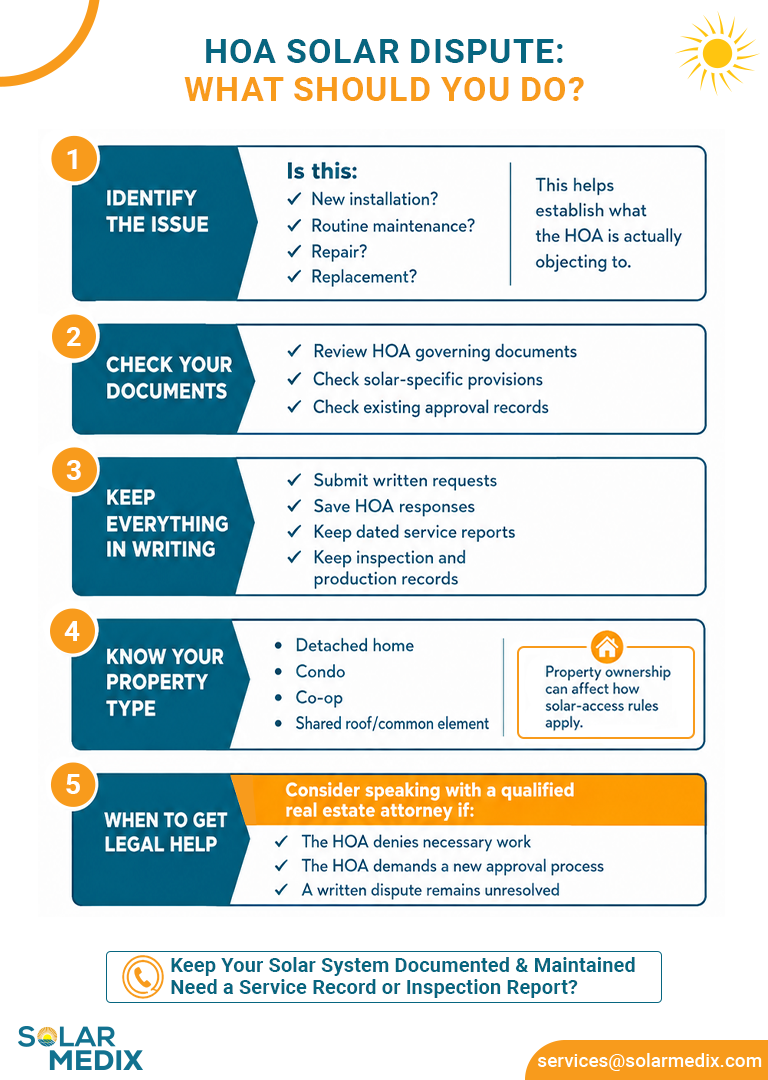
Start by reviewing your HOA’s governing documents and any solar provisions, keep everything in writing, and document that the work is maintenance or repair of an existing, approved system rather than a new installation. Clear records and a professional service report usually resolve routine pushback.
Can a neighbor’s tree that shades my panels be addressed?
Sometimes, through solar-easement or solar-access provisions, but it’s highly situation-specific and often a legal question rather than a service one. On the system side, we can document the shading and its production impact, which is useful evidence in any discussion.
How does Solar Medix help with HOA or access issues?
We’re not a law firm and don’t give legal advice, but we provide the professional service records, inspection reports, and production documentation that support your case, and we keep your system properly maintained so it stays compliant and in good standing.