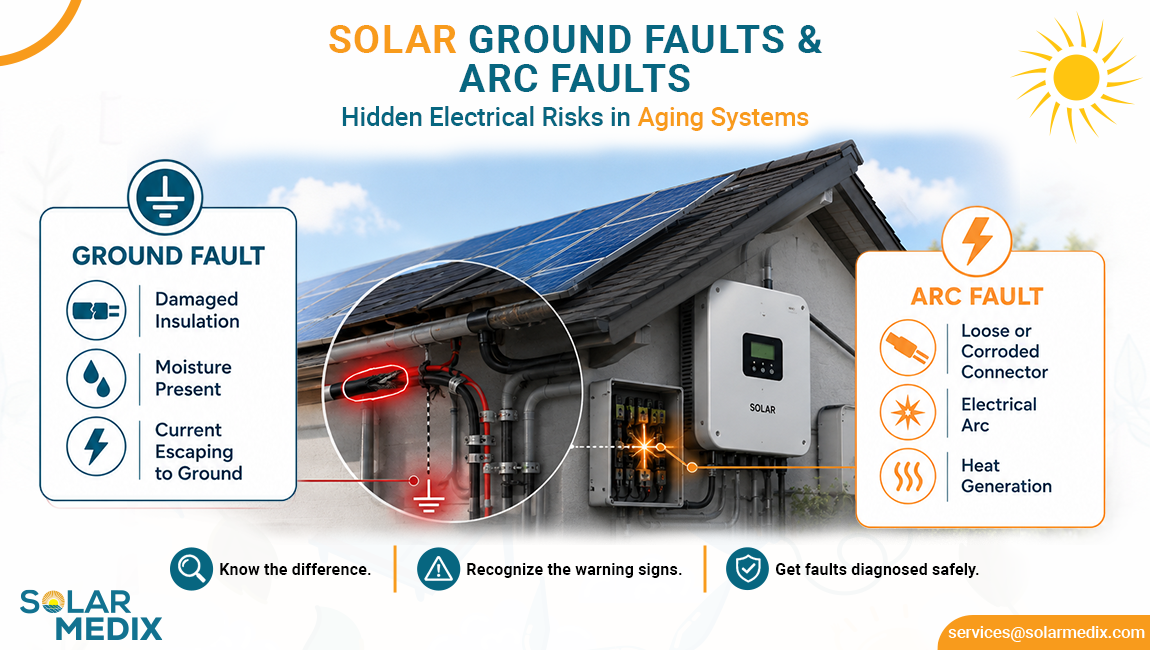
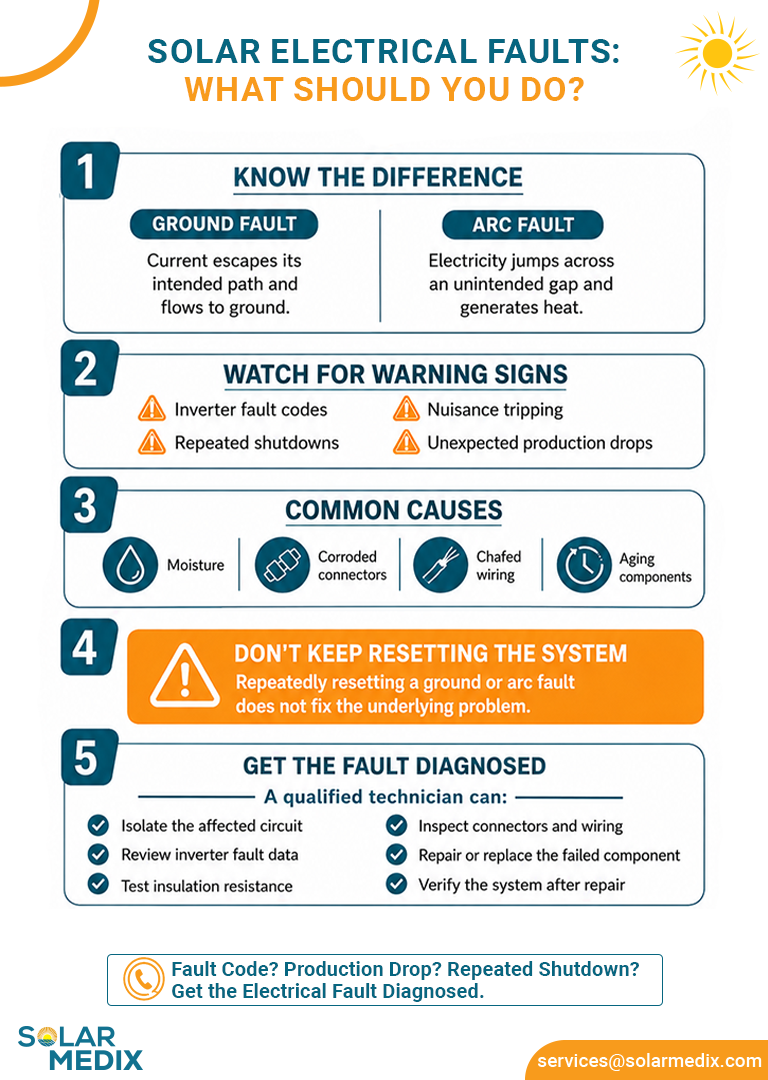
A solar ground fault lets current escape through damaged insulation or moisture, while an arc fault occurs when electricity jumps across a gap, usually at a loose or corroded connection, creating heat and potential fire risk. Both can become more likely as systems age, and warning signs include inverter fault codes, nuisance tripping, and unexplained production drops.
Aging solar systems are often discussed in terms of declining output or panel replacement, but electrical faults can create more immediate performance and safety concerns. Insulation can degrade, connectors can loosen, and moisture can enter connections over time. This guide explains the difference between ground and arc faults, the causes and warning signs to watch for, and how technicians diagnose and repair them using inverter error data and insulation resistance testing rather than repeatedly resetting the system.
Solar Ground Faults and Arc Faults: What These Terms Actually Mean
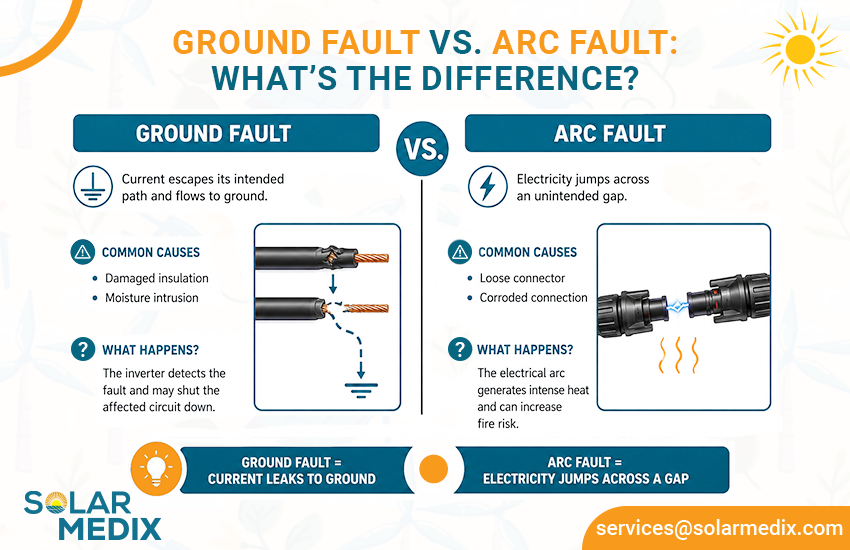
Solar ground faults and arc faults are two different electrical problems: a ground fault involves unintended current flowing to ground, while an arc fault occurs when electricity jumps across a damaged or loose connection.
What a Ground Fault Is
A ground fault occurs when current escapes its intended path, usually because wiring insulation has been damaged or moisture has gotten in, and flows to ground instead. Your inverter’s ground-fault detection is specifically built to catch this: it senses the fault and typically shuts the system down, which protects you but also halts production until the underlying issue is fixed.
What an Arc Fault Is
An arc fault occurs when electricity jumps across an unintended gap, creating intense heat at the connection point and increasing the risk of fire. It can develop when a connector becomes loose, damaged, or corroded, allowing current to bridge the gap rather than flow through a continuous connection. Because the resulting heat can damage components and ignite surrounding materials, modern inverters use dedicated arc-fault detection to identify these conditions separately from ground faults.
What Causes Ground and Arc Faults in Aging Systems
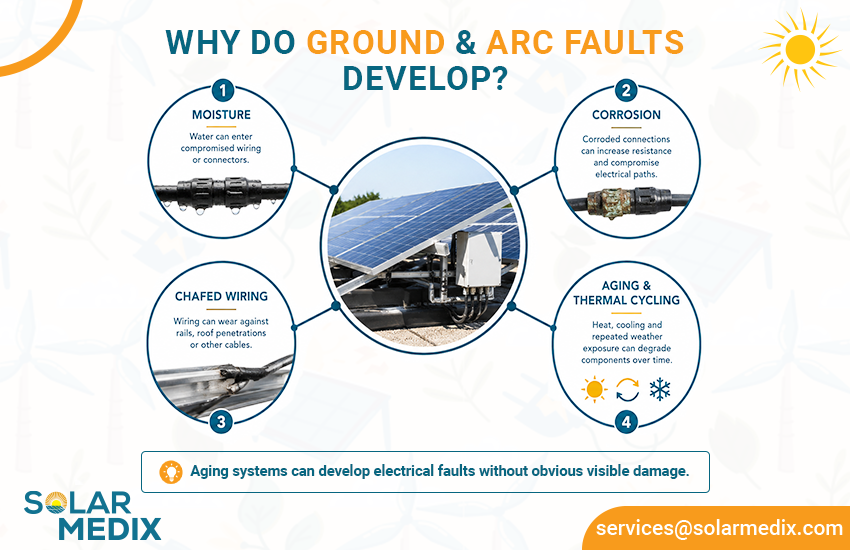
Both ground and arc faults in aging solar systems are usually caused by components deteriorating over time from heat, moisture, weather exposure, vibration, and repeated thermal cycling.
Moisture Ingress and Corroded Connectors
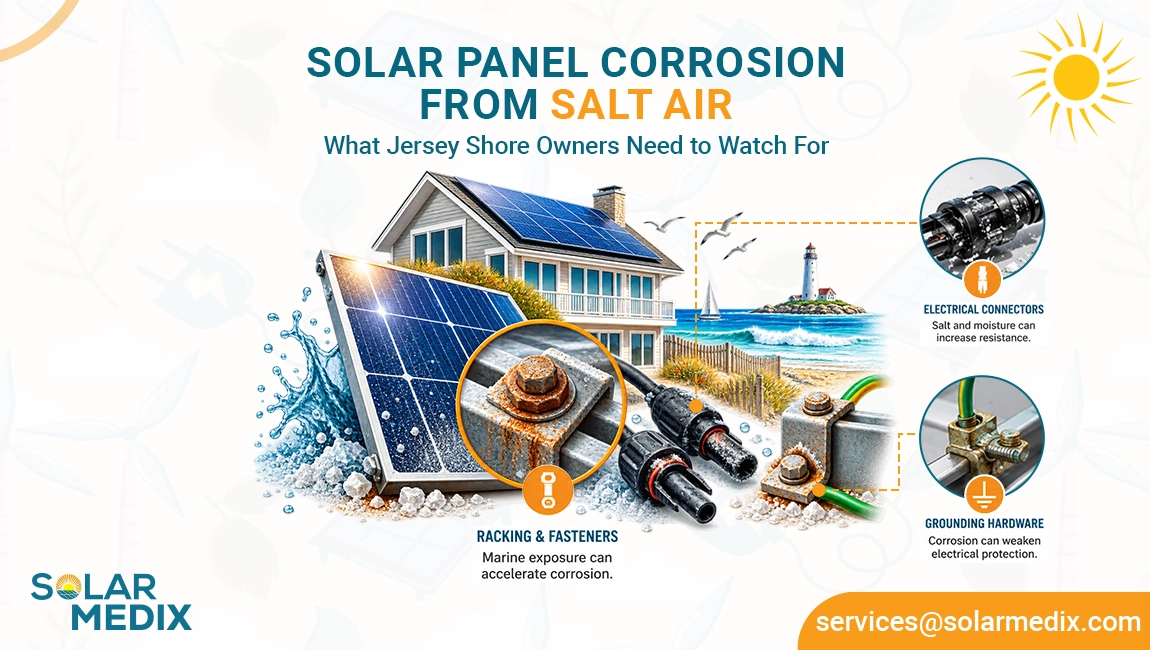
Moisture ingress into wiring and connectors is one of the most common root causes of a ground fault, since water finding its way past a compromised seal or a cracked jacket lowers insulation resistance and gives current a path it shouldn’t have. Sandia and NREL’s ongoing research into PV connector reliability has flagged connector failure as a rising factor in PV system reliability issues, driven in part by field-aged cable jackets and connectors that were never designed for decades of outdoor exposure. Corroded connectors compound the problem, since corrosion itself increases resistance at the exact point current is trying to pass through cleanly.
Chafed Wiring and Isolation Faults
Wiring that rubs against a mounting rail, roof penetration, or another cable over years of thermal expansion and contraction can wear through its insulation at a single contact point, creating what’s known as an isolation fault. Unlike a fully severed wire, a chafed spot might only cause an intermittent problem at first, showing up under specific temperature or moisture conditions before becoming a consistent fault as the damage worsens.
What Do Ground and Arc Fault Warnings on Your Inverter Mean?
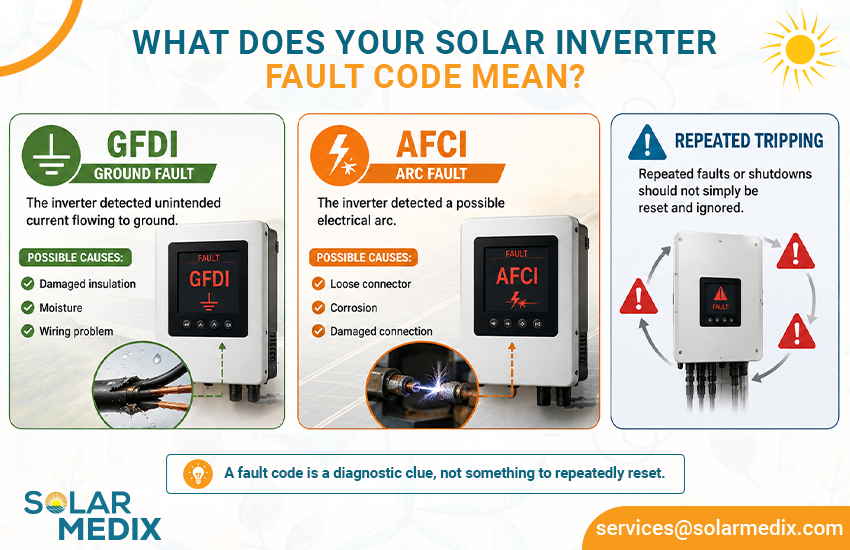
A ground fault error usually shows up as a GFDI trip on your inverter display, meaning the ground-fault detection and interruption system has sensed a fault and shut the affected circuit down, while an arc fault typically appears as a distinct AFCI or arc-fault error code. Nuisance tripping, where the inverter faults repeatedly without an obvious cause, is often an early sign of exactly this kind of intermittent connection issue rather than a false alarm to dismiss. Nuisance tripping, where the inverter faults repeatedly without an obvious cause, can be an early sign of an intermittent connection issue rather than a false alarm to dismiss. These faults can also contribute to underperforming solar panels and output loss before an error code appears on the display.
How Are Ground and Arc Faults Diagnosed and Repaired?
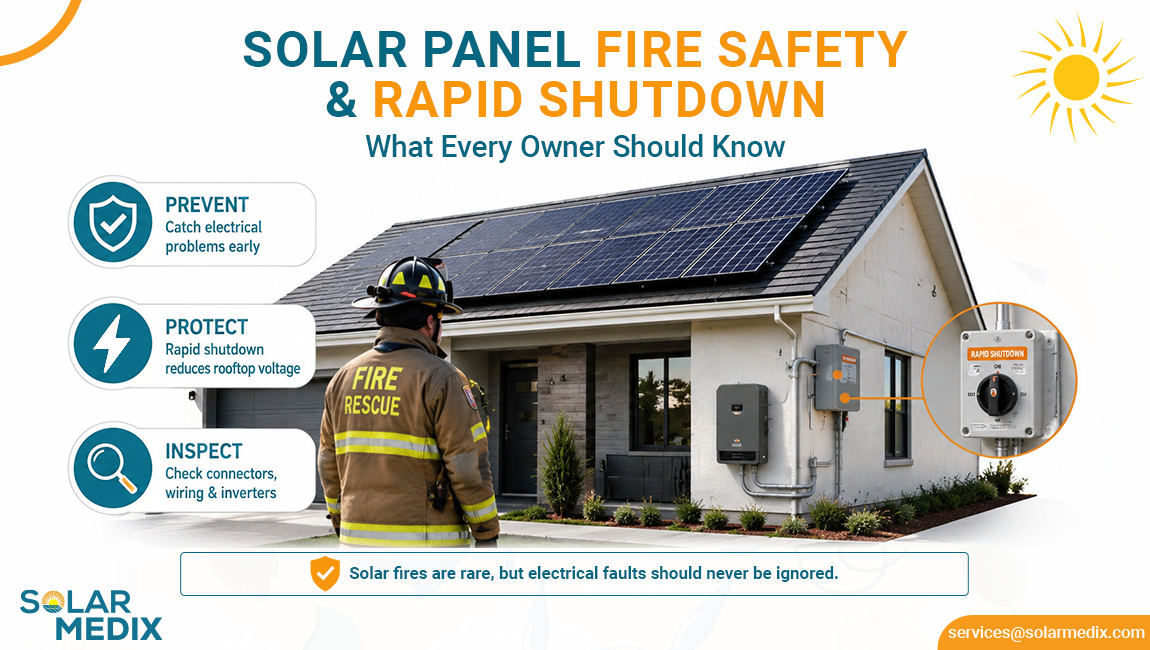
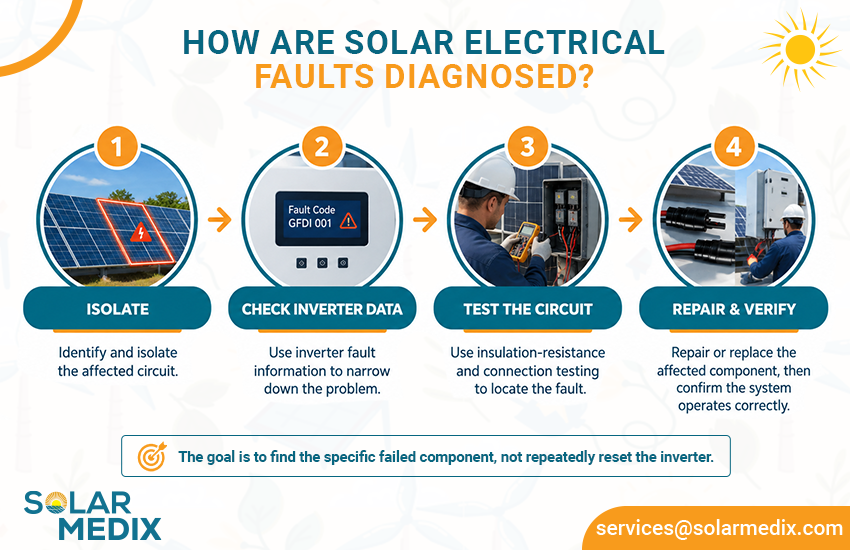
Solar electrical fault diagnosis follows a consistent process regardless of which fault triggered it: isolate the affected circuit, locate the specific point of failure, and confirm the fix before restoring power. The IAEI’s overview of PV fire and personnel safety requirements outlines how GFDI and AFCI systems are required to isolate a faulted circuit and indicate the fault, which is exactly what a technician’s diagnostic process is built around confirming and then correcting.
How Technicians Diagnose the Fault
Solar arc fault detection and ground fault diagnosis both rely on a combination of the inverter’s own fault data and physical testing. An insulation resistance test measures how well a circuit’s insulation is holding up and pinpoints where resistance has dropped low enough to explain a ground fault, while a visual and thermal inspection of connectors along the suspect circuit typically reveals the specific arc-fault location. Together, these narrow a fault down from an entire circuit to a specific connector or section of cable.
Why DIY Diagnosis and Repair Isn’t Safe
Both fault types involve live, potentially high-voltage DC wiring, and a fault that’s tripped once can re-energize unpredictably if someone attempts to reset and diagnose it without the right equipment and training. Repeatedly resetting the inverter and hoping the fault clears is not harmless troubleshooting when a ground or arc fault is involved. Understanding whether a solar inverter needs repair or replacement and how solar system fault-finding works can help put the issue in context, but residential ground and arc faults require targeted electrical testing rather than repeated resets.
Get a Fault Diagnosed Before It Becomes a Bigger Problem
A solar ground fault or arc fault rarely gets better on its own, and repeatedly resetting an inverter that keeps tripping only delays a fix that’s going to be necessary anyway. Solar Medix diagnoses both fault types using insulation resistance testing and targeted inspection, then repairs or replaces the specific wiring, connector, or component causing the problem, regardless of who installed the system originally. If your inverter has been showing a fault code, tripping without explanation, or you’ve noticed output that doesn’t match what your panels should be producing, that’s worth a diagnostic visit before it becomes a safety issue rather than a performance one.
FAQs
What is a ground fault in a solar system?
A ground fault happens when current escapes its intended path, usually because wiring insulation has been damaged or moisture has gotten in, and flows to ground. Your inverter’s ground-fault protection detects this and often shuts the system down, which protects you but also stops production until it’s fixed.
What’s the difference between a ground fault and an arc fault?
A ground fault is current leaking to ground through damaged insulation. An arc fault is electricity jumping across a gap, for example at a loose or corroded connector, which creates heat and is a genuine fire risk. Both are more common in aging systems, and modern inverters are designed to detect each.
Why does my solar inverter keep shutting down or showing a fault code?
Repeated shutdowns or ground-fault and arc-fault error codes usually point to a wiring or connector problem: chafed cable, water intrusion, or a corroded connection somewhere in the array. It’s not something to reset repeatedly; the fault should be located and corrected by a technician.
Are ground faults and arc faults dangerous?
They can be. Beyond killing your production, arc faults in particular generate heat and can start fires, and both indicate compromised wiring that needs professional attention. They’re a leading reason not to ignore a system that keeps failing or won’t stay on.
How are these faults found and repaired?
A technician isolates the fault using the inverter’s diagnostics plus insulation-resistance and connection testing, traces it to the damaged section, and repairs or replaces the affected wiring, connector, or component, then verifies the system runs cleanly. Our guide to why solar panels stop producing power covers the broader range of causes worth ruling out alongside a suspected fault.