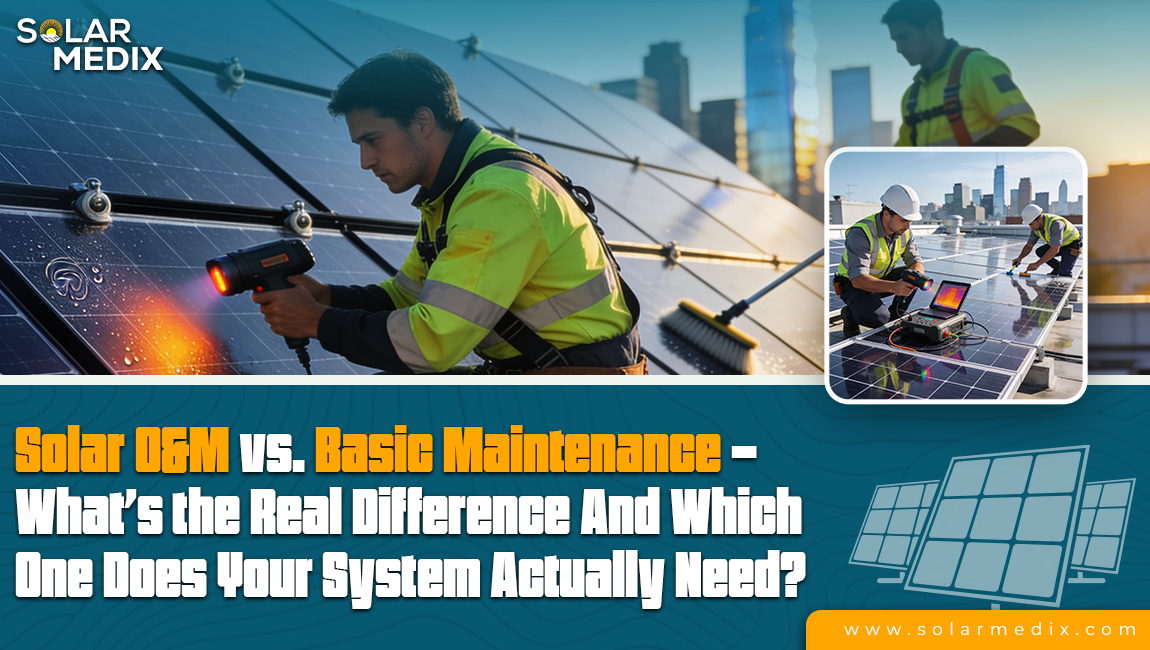
Solar O&M is full care for your system, including monitoring, repairs, and performance checks. Basic maintenance is simpler, like cleaning and basic inspections. New systems may only need maintenance, but older or bigger systems usually need O&M.
A lot of people think solar panels are completely hands-off once they are installed.
We get why.
The panels are on the roof. The sun comes out. The app shows some numbers. The electric bill looks lower than it used to. So it feels like everything is fine.
But solar systems still need care.
Not always a huge amount. Not always every month. But they do need someone checking that the system is clean, safe, connected, and producing the way it should.
This is where the confusion starts.
Some homeowners only need basic solar maintenance.
Some homes and most commercial systems need a proper solar O&M plan.
They sound similar, but they are not the same thing.
At Solar Medix, we work on systems every week where the owner thought everything was fine until the bill changed, the inverter stopped reporting, a panel underperformed, or a small issue sat there too long.
So let’s make this simple.
Basic maintenance is like taking your car in for a basic service.
Solar O&M is more like having someone actively watch, manage, and support the whole system over time.
Both can be useful. The right choice depends on your system size, age, location, monitoring, and how much risk you are comfortable carrying.
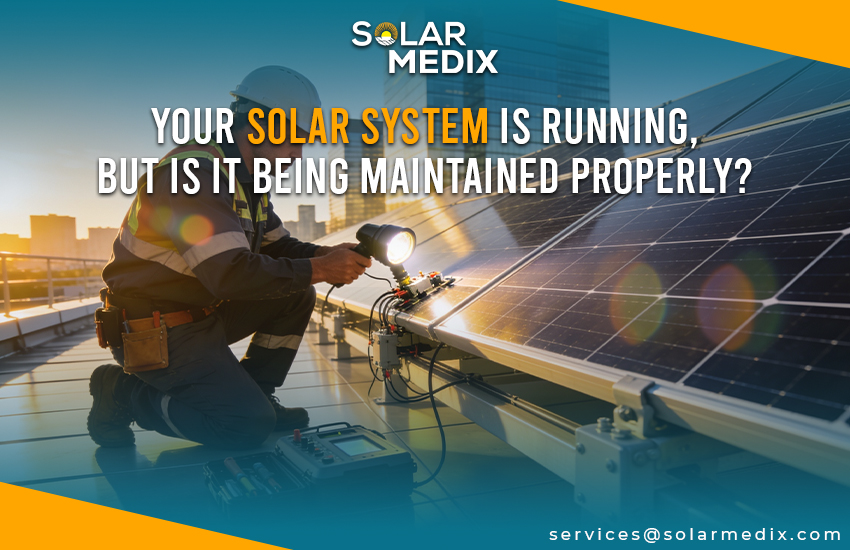
Your Solar System Is Running, But Is It Being Maintained Properly?
Just because a solar system is running does not mean it is running well.
That is the part many people miss.
A system can still produce power while losing output quietly. It can still show activity on the app while one section is underperforming. It can still look fine from the ground while wiring, critters, soiling, or inverter issues are starting to cause trouble.
That is why maintenance matters.
Not because every system is fragile.
Because small issues are easier to fix when they are found early.
Do Solar Panels Require Maintenance After Installation?
Yes, solar panels and the wider solar system need maintenance after installation.
Solar panels themselves are built to last, but the system is more than panels. You also have inverters, wiring, mounting, monitoring devices, roof attachments, and electrical connections.
The National Renewable Energy Laboratory’s PV O&M best practice guide explains that operations and maintenance helps improve reliability, availability and safety across PV systems, not just panel appearance.
To put it simply:
Your system may not need constant attention, but it should not be ignored for years either.
What Happens To A Solar System That Is Never Serviced?
If a solar system is never serviced, small problems can sit there for months or even years. You may not notice straight away. The system may still produce some power, but not as much as it should.
Common problems we see include:
- Dirty panels
- Loose or worn wiring
- Inverter faults
- Monitoring dropouts
- Critter damage
- Failed optimisers
- Roof-related solar issues
- Water or weather damage
- One section of the system underperforming
Sometimes the owner only finds out when the utility bill starts rising. That is not the best time to learn something has been wrong for months.
How Undetected Performance Loss Can Cost You Money
If your system is meant to reduce your electric bill, then every lost bit of production matters. A small drop may not look dramatic on one day. But over months, it adds up.
For a homeowner, that may mean higher bills.
For a business, it can mean lost savings across a much larger system.
Our Solar O&M service helps with performance monitoring, preventive inspections, inverter diagnostics, panel performance checks, warranty coordination, and corrective maintenance for residential and commercial systems.
That is the real point of O&M. It is about keeping the system doing the job it was installed to do.
What Is Solar Soiling And How Does It Affect Output?
Solar soiling means dirt, dust, pollen, leaves, bird droppings, or other material sitting on the panel surface.
It blocks sunlight. Less sunlight reaching the panel means less power produced.
NREL research notes that natural soiling reduces PV energy output and increases the cost of energy from the system because deposits on PV surfaces reduce light reaching the cells.
That does not mean every panel needs cleaning every few weeks.
It depends on your location.
A home near trees, dust, pollen, birds, or heavy weather exposure may need more attention than a cleaner, open rooftop.
Why Set And Forget Solar Can Become Expensive
Solar is often sold like this: “Install it, then enjoy the savings.” That part sounds great.
But “never check it again” is where the problem starts. A solar system is still an electrical asset on your roof or property.
If monitoring drops out, you may not know production has fallen. If critters get under the panels, the damage may grow. If an inverter starts failing, the system may underperform before it stops completely.
We have seen simple issues become expensive because nobody checked early.
That is why we like to catch problems while they are still small.
How Often Should A Home Solar System Be Inspected?
For many homes, a yearly professional inspection is a sensible starting point.
Some systems may need more frequent checks if they are older, heavily shaded, exposed to dust or pollen, have critter activity, have had roof work, or have monitoring problems.
Commercial systems often need a stronger schedule because the system is larger, the financial impact is bigger, and downtime can be more costly.
We recommend that residential O&M is typically performed annually or on a reactive basis, while commercial O&M may involve quarterly or biannual schedules, depending on the system and site requirements.
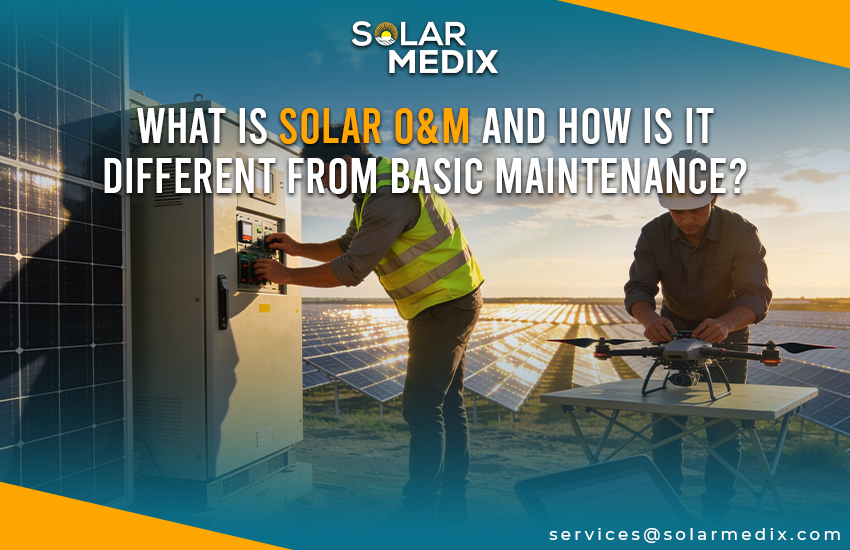
What Is Solar O&M And How Is It Different From Basic Maintenance?
Here is the easy way to think about it. Basic maintenance checks the condition of the system. Solar O&M manages the performance of the system.
They overlap, but O&M goes much deeper.
What Does Solar O&M Mean?
Solar O&M stands for Operations and Maintenance.
It means the system is not just cleaned or checked once in a while. It is actively managed, monitored, inspected, diagnosed, and supported so it can keep performing over time.
O&M can include:
- Performance monitoring
- Inverter health checks
- Preventive inspections
- Corrective repairs
- Fault response
- Reporting
- Warranty support
- Safety checks
- Cleaning where needed
- Troubleshooting
- Replacement planning
- Response-time expectations
That is a bigger job than a quick clean.
What Does Basic Solar Maintenance Include?
Basic solar maintenance usually includes the simpler care items.
That may include:
- Visual panel inspection
- Cleaning if needed
- Basic inverter check
- Basic production review
- Checking for obvious damage
- Looking for loose wiring or visible wear
- Checking for debris, leaves, or bird activity
- Making sure monitoring is still accessible
For many newer home systems, this may be enough for a while. Especially if the system is monitored, performing well, and does not have any known issues.
What Does Solar O&M Include That Basic Maintenance Does Not?
Solar O&M usually includes more active management.
That can include:
- Continuous or regular performance monitoring
- System reporting
- Fault detection
- Inverter diagnostics
- Planned inspections
- Maintenance scheduling
- Warranty coordination
- RMA support
- Repair recommendations
- Response-time expectations
- Commercial compliance and safety checks
- Long-term performance planning
Here is the difference in a simple table.
|
Area |
Basic Solar Maintenance |
Full Solar O&M |
| Main goal | Keep the system clean and checked | Keep the system performing and managed |
| Monitoring | Basic app or production check | Regular or active performance review |
| Inverter checks | Basic status check | Deeper fault and health diagnostics |
| Reporting | Often minimal | Formal reports may be included |
| Repairs | Usually quoted after issue is found | Often part of a planned support process |
| Warranty help | Limited | Warranty and RMA support may be included |
| Response time | Usually not guaranteed | May include service response expectations |
| Best fit | Newer, smaller home systems | Commercial, larger, older or higher-risk systems |
What Is A Solar O&M Contract?
A solar O&M contract is an agreement that explains what services are included and how the system will be supported.
A good O&M contract may cover:
- Inspection frequency
- Monitoring responsibilities
- Response times
- Reporting
- Emergency support
- Preventive maintenance
- Corrective maintenance
- Cleaning schedule
- Inverter checks
- Warranty support
- Repair approval process
- What is included and what is billed separately
For commercial systems, the contract matters even more because the system may be tied to operating costs, compliance, investor expectations, or business energy savings.
What Is A Service Level Agreement In A Solar O&M Plan?
A Service Level Agreement, or SLA, sets expectations around response times and support. For example, an SLA may explain:
- How quickly faults are reviewed
- How urgent issues are handled
- How soon a technician is dispatched
- What happens after monitoring alerts
- What reports are provided
- What level of uptime or response is expected
Not every home maintenance plan needs a formal SLA. Commercial systems often do.
If a business system goes down, the lost production may have a direct financial impact.
What Is NABCEP Certification?
NABCEP stands for the North American Board of Certified Energy Practitioners.
It is a recognised credentialing organisation for solar and renewable energy professionals in North America. NABCEP also lists an Operations & Maintenance Associate Technician credential for solar O&M work.
Why does that matter?
Because O&M is technical.
You want people who understand solar systems, safety, diagnostics, inverter behaviour and long-term performance, not someone guessing from the ground.
Residential Solar Maintenance vs Commercial Solar O&M
Residential and commercial solar systems are not the same.
A home system may be smaller, simpler and easier to access.
A commercial system may be larger, more complex, and more expensive to leave underperforming.
Commercial systems often involve larger system size, stricter safety requirements, greater downtime impact and more detailed reporting needs than residential systems. So while a homeowner may need a strong maintenance plan, a business may need a full O&M programme.
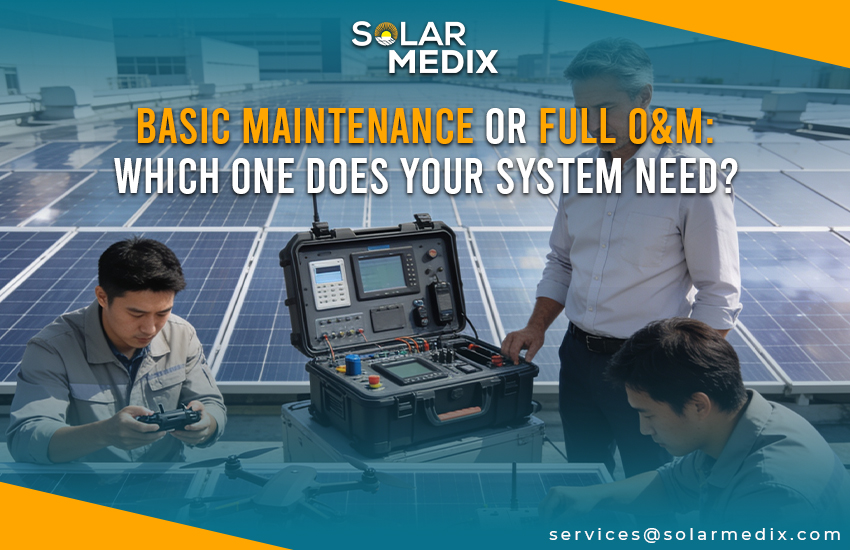
Basic Maintenance Or Full O&M: Which One Does Your System Need?
This is the real question. You do not want to overpay for a plan you do not need. You also do not want to under-service a system that needs proper management.
So let’s make it practical.
Who Needs Basic Solar Maintenance?
Basic solar maintenance may be enough if:
- Your system is newer
- Your monitoring is working
- Your production looks normal
- The system is small
- There are no visible issues
- There is no critter activity
- Your inverter is not showing faults
- You just need cleaning and an annual inspection
For many homeowners, this is a good starting point.
A yearly check can confirm the system is clean, safe, and producing properly.
Who Needs A Full Solar O&M Plan?
Full O&M may be a better fit if:
- Your system is commercial
- Your system is large
- Your system is older
- Monitoring is not working
- Production has dropped
- You have had repeated repairs
- The original installer is gone
- You need warranty or RMA support
- You need formal reports
- Downtime costs you money
- You want planned response instead of emergency calls
If your system is important to your bills, operations, or business savings, O&M is usually worth discussing.
New System vs Aging System: How Service Needs Change Over Time
A new system may only need basic checks at first.
But as the system ages, the risks change.
Over time, you may start seeing:
- Inverter issues
- Monitoring failures
- Wiring wear
- Panel degradation
- Roof-related issues
- Critter damage
- Connector problems
- Warranty questions
- Harder-to-source parts
That does not mean the system is failing.
It means it needs more active care as it gets older.
A 2-year-old system and a 12-year-old system should not always be managed the same way.
Monitored vs Unmonitored Systems: Why It Matters
Monitoring changes everything. If monitoring is working properly, we can see when production drops, when the inverter faults, or when performance changes. If monitoring is not working, you may not know there is a problem until the utility bill changes.
That is one of the biggest reasons homeowners call us.
They thought the system was fine.
Then they realise the app has not updated in months.
Solar Medix works on monitoring issues as part of broader repair and O&M support, including monitoring failures that make it hard to see system performance clearly.
If your monitoring is down, that is not something to ignore.
Residential vs Commercial Solar: Different Service Requirements
Homeowners and businesses usually have different needs.
For homeowners, the main goal is usually lower bills and a system that keeps working without surprises.
For businesses, the system may support operating savings, sustainability goals, and larger financial returns.
Commercial systems often need:
- More frequent inspections
- Better reporting
- Faster response
- Safety documentation
- Performance tracking
- Preventive maintenance
- Clear repair planning
Solar Medix’s commercial O&M options include preventive maintenance, corrective and reactive O&M, monitoring-driven O&M and full-service commercial O&M.
That is a different level of care than a simple annual clean.
The Cost Of Solar O&M vs Reactive Emergency Repair
Reactive repair means waiting until something breaks, then calling for help. Sometimes that works. But it can also be more expensive.
Why?
Because by the time you notice the issue, you may already have:
- Lost weeks or months of production
- Bigger repair work
- Inverter downtime
- More damage under the panels
- Emergency service costs
- Harder warranty documentation
- A business system sitting idle
O&M is about catching issues before they become painful. It does not prevent every problem.
But it gives you a better chance of finding issues early, planning repairs and protecting production.
What Research Says About Undetected Solar Performance Loss
NREL’s PV O&M best practices guide focuses on improving the reliability, availability and safety of PV systems through proper operations and maintenance.
That matters because performance loss is not always obvious.
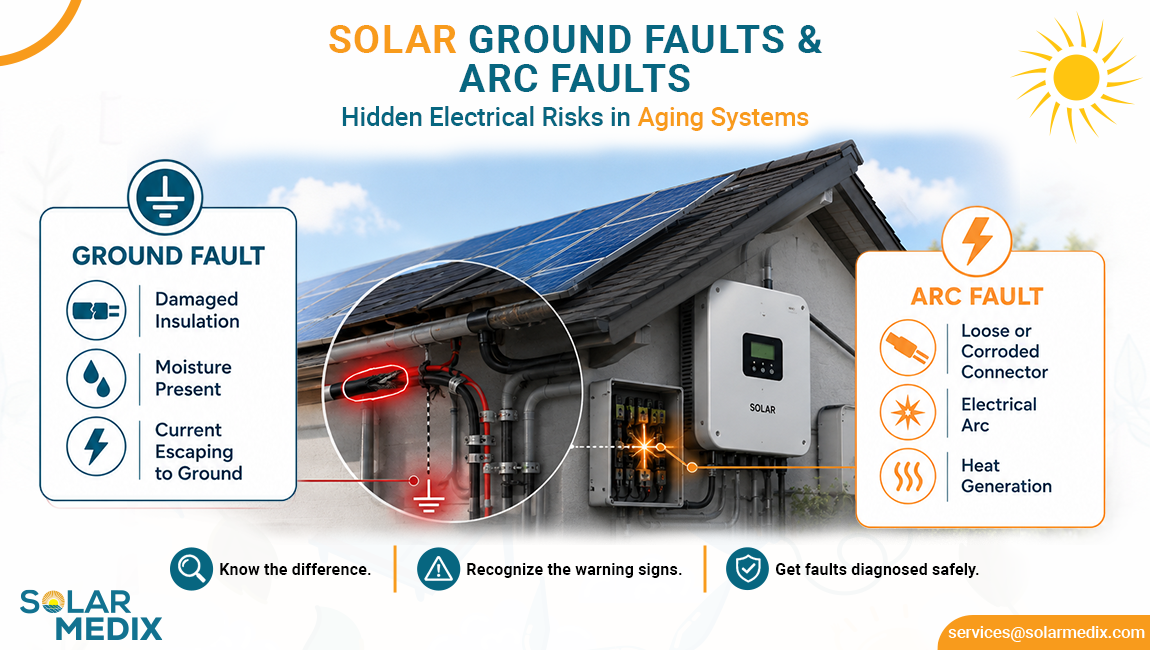
Soiling, monitoring failures, inverter issues, and wiring problems can all reduce output without the system looking “broken” from the outside.
This is why we always say:
Do not judge the system only from the ground. Look at the data. Check the equipment. Inspect the roof. Confirm the cause.
What To Look For In A Solar O&M Provider
Look for a provider that can do more than clean panels.
You want a team that can help with:
- Monitoring
- Inverter diagnostics
- Repairs
- Warranty support
- Reporting
- Electrical troubleshooting
- Roof-related solar work
- Commercial system support
- Residential system support
- Systems they did not install
Keeping your solar system running efficiently takes the right support. Solar Medix provides the ongoing O&M services needed to help protect your investment for the long term.
Can A Third-Party Provider Handle O&M For A System They Did Not Install?
Yes. This is a big part of what we do. Solar Medix works on solar systems installed by other companies, including systems where the original installer is gone, slow to respond, or no longer servicing older systems.
Solar Medix provides solar repair, inverter repair, warranty assistance, monitoring support, critter solutions, and solar removal and reinstallation services across New Jersey, New York, Texas, and Massachusetts.
So no, you do not have to stay stuck just because your original installer is not helping.
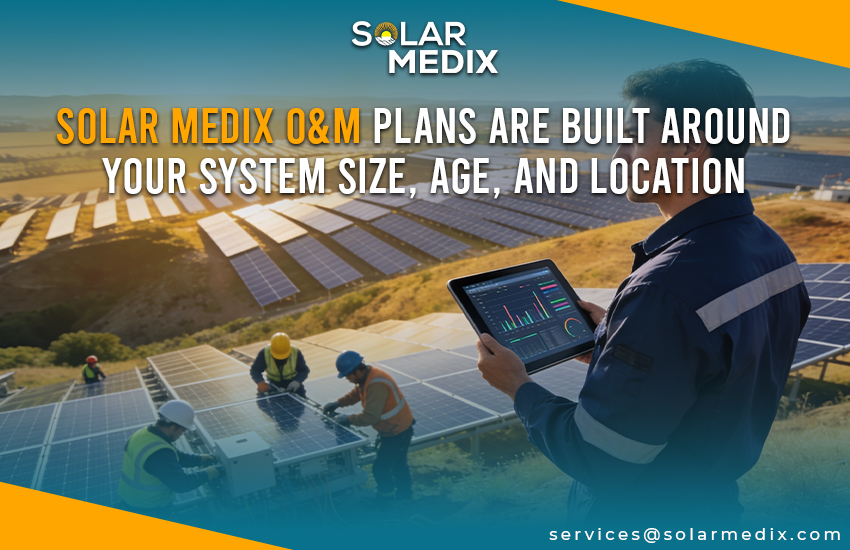
Solar Medix O&M Plans Are Built Around Your System Size, Age, and Location
There is no one-size plan that fits every solar system.
A small home system in New Jersey does not need the same support as a large commercial system in Texas.
A new system with working monitoring does not need the same level of care as an older system with inverter faults and missing service history.
That is why we build O&M recommendations around the system itself.
What Is Included In A Solar Medix O&M Plan?
Depending on the system, a Solar Medix O&M plan includes:
- System inspection
- Performance review
- Monitoring support
- Inverter diagnostics
- Panel condition checks
- Preventive maintenance
- Corrective maintenance
- Repair recommendations
- Warranty coordination
- RMA assistance
- Cleaning recommendations
- Safety checks
- Reporting
- Commercial support where needed
Solar Medix’s O&M services cover monitoring, maintenance, repairs, and warranty support for both home and business solar systems.
The aim is simple.
Keep the system performing and help you avoid surprise failures.
How Much Does A Solar O&M Plan Cost With Solar Medix?
The cost depends on the system.
We need to know things like:
- System size
- Location
- Age
- Roof access
- Monitoring status
- Residential or commercial use
- Current problems
- Equipment type
- Inspection frequency
- Reporting needs
- Whether repairs are already needed
A small home system may only need a simple maintenance plan. A commercial system may need more regular inspections, monitoring, reporting, and response support.
That is why we quote based on the actual system, not a rough guess.
Solar Medix Services Systems We Did Not Install
You do not need to have installed your system with Solar Medix. We can help with systems installed by other companies.
That includes systems where:
- The original installer closed
- The installer stopped responding
- The system is older
- Monitoring is down
- Production has dropped
- A previous issue was misdiagnosed
- The system needs warranty support
- The owner wants a second opinion
Residential O&M, Commercial O&M And Texas Solar Maintenance
Solar Medix supports residential and commercial systems, including solar O&M needs across New Jersey, New York, Texas, and Massachusetts.
Residential systems often need cleaning, inspection, monitoring checks, and repair support.
Commercial systems usually need more structured care, better reporting, and faster issue response because downtime can affect business savings.
How To Get A Custom O&M Quote Based On Your System
To build the right O&M quote, we usually need:
- Your location
- System size
- System age
- Panel and inverter brand, if known
- Whether monitoring is working
- Any current problems
- Residential or commercial use
- Roof access details
- Whether the original installer is still available
- Any recent utility bill or production concerns
From there, we can recommend basic maintenance, full O&M, repair support, or monitoring help.
The point is not to sell the biggest plan.
The point is to match the plan to the system.
Solar O&M Support Across New Jersey, New York, Texas And Massachusetts
Solar Medix provides solar O&M, maintenance, repair, and monitoring support across New Jersey, New York, Texas, and Massachusetts. Solar Medix also lists service locations in New Jersey, New York, Houston, TX, and Boston, MA.
If your system is running but nobody is really watching it, now is a good time to check what level of support it needs.
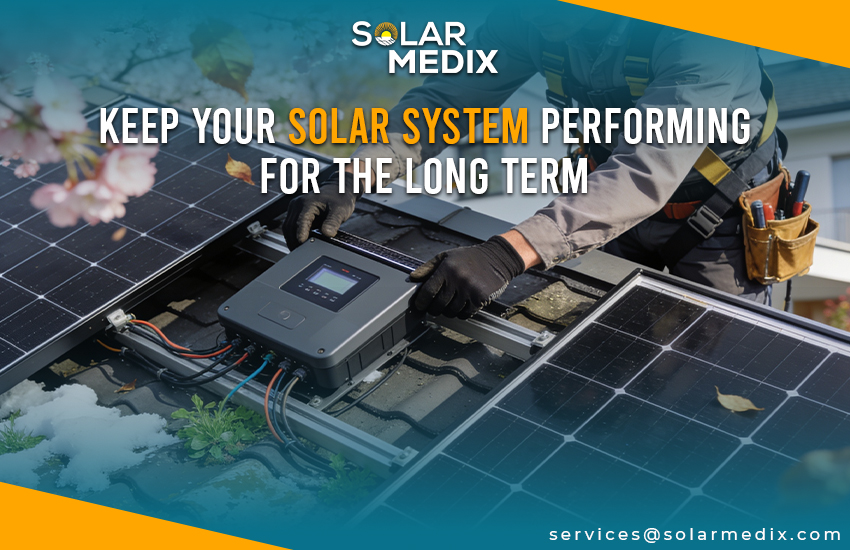
Keep Your Solar System Performing For The Long Term
Your solar panels were meant to work for years.
But they still need the right care.
For some homeowners, that may mean basic maintenance once a year.
For older homes, unmonitored systems, commercial systems or larger arrays, that may mean a proper O&M plan with monitoring, diagnostics, reporting and repair support.
At Solar Medix, we help you work out what your system actually needs.
Not more.
Not less.
Just the right level of care to keep it safe, productive and worth the investment.
FAQs
What does solar O&M stand for?
Solar O&M stands for Operations and Maintenance. It means the system is monitored, inspected, maintained, repaired, and managed so it can keep performing properly over time.
What is the difference between solar O&M and basic solar maintenance?
Basic solar maintenance usually includes cleaning, visual checks and a simple performance review. Solar O&M goes further with monitoring, diagnostics, reporting, warranty support, repair planning and response expectations.
Does my home solar system need an O&M plan?
Some home systems only need basic maintenance, especially if they are newer and monitoring is working. Older systems, unmonitored systems, larger systems, or systems with repeated issues may need a stronger O&M plan.
What does a solar O&M contract typically include?
A solar O&M contract may include inspections, monitoring, inverter checks, reporting, preventive maintenance, repair support, warranty coordination, response times and details on what is included or billed separately.
What is an SLA in a solar O&M plan?
An SLA, or Service Level Agreement, sets expectations around response times, support levels, reporting, and how quickly issues are reviewed or addressed. SLAs are more common in commercial O&M plans.
How much does a residential solar O&M plan cost?
The cost depends on system size, age, location, roof access, monitoring status, and service needs. A small home system may only need basic maintenance, while an older or more complex system may need a custom O&M plan.
What is the ROI of solar O&M compared to reactive repairs?
Solar O&M can help protect ROI by finding issues earlier, reducing downtime, and avoiding larger emergency repairs. Reactive repairs may cost more if the problem has already caused production loss or wider damage.
At what system age or size does O&M become necessary?
There is no single age or size where O&M becomes necessary for every system. Larger systems, older systems, commercial systems, and unmonitored systems usually benefit from stronger O&M support.
What is NABCEP certification and why does it matter for solar maintenance?
NABCEP is a recognised solar credentialing organisation in North America. It matters because solar maintenance and O&M require technical skill, safety awareness and proper diagnostic knowledge.
Can Solar Medix provide O&M for a system they did not originally install?
Yes. Solar Medix services systems installed by other companies, including systems where the original installer is gone, unresponsive, or no longer servicing older installs.
Does Solar Medix offer commercial solar O&M services?
Yes. Solar Medix offers commercial solar O&M services, including preventive maintenance, corrective support, monitoring-driven O&M and full-service options.
Does Solar Medix offer solar O&M in Texas, Massachusetts, New York and New Jersey?
Yes. Solar Medix provides solar O&M, maintenance and repair support across Texas, Massachusetts, New York and New Jersey.