If your solar app shows zero production, your inverter has warning lights or error codes, or your electricity bill suddenly jumps, your inverter may be failing. Get it checked early before it turns into a full replacement.
Your solar panels might be perfectly fine.
But if the inverter is struggling, your system still may not be doing its job.
That is the part many homeowners miss.
The panels get most of the attention because they are the part you can see on the roof. But the inverter is the part that makes the solar power usable. When it starts failing, your system can lose production, stop reporting properly, trip breakers, or shut down completely.
And the frustrating part?
You may not notice straight away.
Sometimes the first clue is a higher electricity bill. Sometimes it is a red light on the inverter. Sometimes the app stops showing data. Sometimes the system looks fine from the outside, but the inverter is already asking for help.
At Solar Medix, we see this all the time. Homeowners call us because something feels off, but they are not sure whether it is the panels, inverter, monitoring, wiring or something else.
That is exactly why inverter diagnostics matter.
You do not want to guess. You want to know what is actually wrong before a small issue becomes a bigger repair.
Your Solar Panels May Be Fine, But Is Your Inverter Still Working Properly?
When a solar system stops producing, most people think the panels have failed. Sometimes they have. But often, the problem is the inverter.
The inverter works hard every day. It takes the power your panels produce and turns it into electricity your home can actually use. So if the inverter is not working properly, the panels may still be making power, but the system may not be delivering that power correctly.
That is why we always check the inverter as part of a proper solar repair diagnosis.
What Is A Solar Inverter?
A solar inverter is the part of your system that converts solar energy into usable electricity. Your panels create DC power. Your home uses AC power. The inverter handles that conversion.
The U.S. Department of Energy explains that an inverter converts direct current electricity generated by solar PV panels into alternating current electricity for use on the electrical grid.
In simple terms:
Your panels collect the sunlight.
Your inverter makes that power useful.
What Does A Solar Inverter Actually Do?
Your inverter does more than just convert power.
Depending on the system, it may also:
- Track production
- Communicate with your monitoring app
- Detect faults
- Shut the system down during unsafe conditions
- Manage power flow
- Work with batteries, if you have a hybrid setup
- Help protect the system from electrical problems
So when the inverter starts failing, it can affect much more than one small part.
It can affect your production, your monitoring, your safety and your bill.
Where Is My Solar Inverter Located?
Most string inverters are installed near the electrical panel, garage, side wall, basement, utility area or outside near the meter.
Microinverters are different.
They are usually installed under the panels on the roof, one per panel or one serving a small group of panels, depending on the setup.
That means a homeowner can often see and check a string inverter from the ground, but microinverters usually need technician access and system-level monitoring to diagnose properly.
How Do I Check My Solar Inverter?
You can do a simple visual check from a safe position.
Look for:
- A green light
- A red or yellow warning light
- Error codes
- A blank display
- Unusual sounds
- Burn marks or smell
- Signs of water damage
- A breaker that has tripped
- Production data in your app
Do not open the inverter.
Do not remove covers.
Do not touch wiring.
Solar inverters involve electrical components, and some issues are not safe for homeowners to handle.
If the display is showing an error, take a photo and contact a solar technician.
String Inverter vs Microinverter: What Is The Difference?
A string inverter usually handles power from a group of panels. If a string inverter fails, a large part of the system, or sometimes the whole system, may stop producing.
A microinverter is usually installed behind each panel or small panel group.
If one microinverter fails, the rest of the system may keep working, but one panel or section may stop producing properly.
Here is the simple difference:
| Type | Where It Is | What Happens If It Fails |
| String inverter | Usually on a wall near electrical equipment | A large part or all of the system may stop producing |
| Microinverter | Usually under the panels | One panel or section may stop producing |
| Hybrid inverter | Near electrical or battery equipment | Solar and battery performance may be affected |
Both types can fail. They just fail in different ways.
How Long Do Solar Inverters Usually Last?
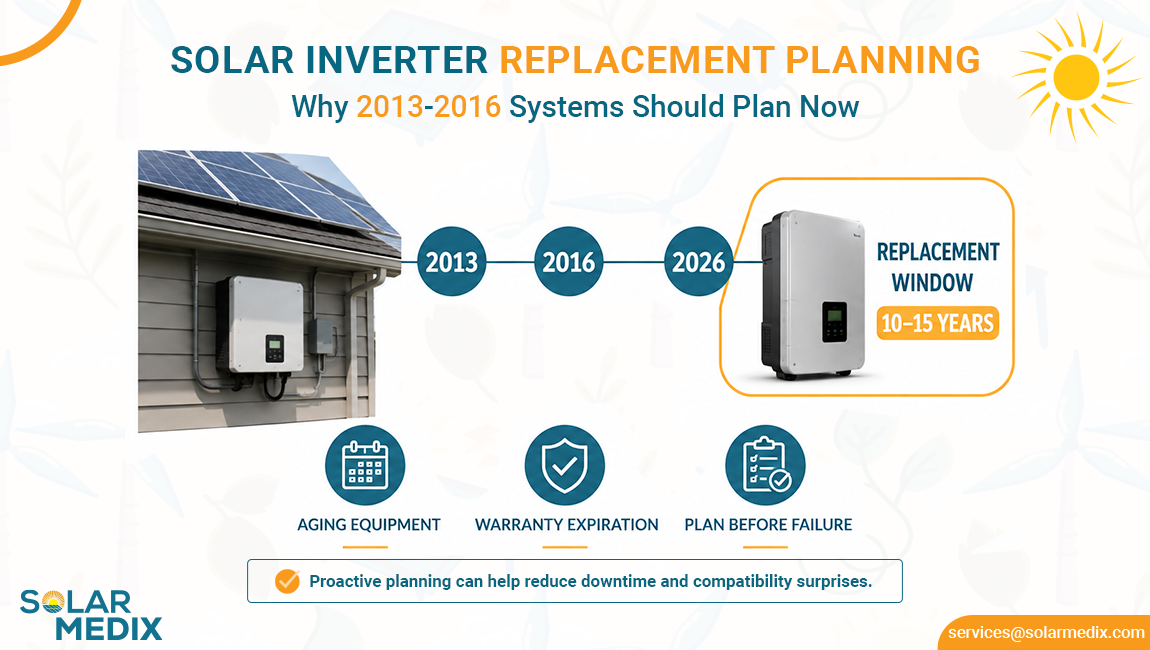
Solar inverter life depends on the brand, model, installation conditions, heat exposure, maintenance and system design. Many solar panels are designed to last for decades, but inverters often need attention sooner than the panels.
That does not mean every inverter will fail early.
But if your system is 10 years old or more and has never been inspected, the inverter should be checked.
Heat, weather exposure, age, electrical stress and poor installation conditions can all shorten inverter life.
What Happens If Your Solar Inverter Fails?
If your inverter fails, your system may:
- Stop producing power
- Show zero production in the app
- Lose monitoring data
- Trip breakers
- Show fault codes
- Produce only part of what it should
- Stop sending solar power to your home
- Trigger safety shutdowns
The panels may still be sitting there doing their part.
But without a working inverter, the system cannot deliver power properly.
That is why inverter problems need quick attention.
10 Early Warning Signs Your Solar Inverter May Be Failing
An inverter usually gives warning signs before it fully fails. The problem is that many homeowners do not know what those signs mean.
Here are the ones we would pay attention to.
Sign 1: Your Solar App Shows Zero Production
If your app suddenly shows zero production during daylight hours, something is wrong.
It could be:
- An inverter fault
- A monitoring issue
- A communication problem
- A breaker issue
- A grid connection issue
- A full system shutdown
Zero production does not always mean the inverter is dead.
But it does mean the system needs checking.
Sign 2: Your Solar App Shows Inconsistent Production
If production is jumping up and down in a way that does not match the weather, the inverter may be struggling.
Some normal variation is expected.
Clouds, shade and weather can all affect output.
But random drops, gaps or strange patterns may point to inverter, wiring or monitoring issues.
At Solar Medix, we always look at the data and the equipment together. The app gives clues, but it does not always tell the full story.
Sign 3: Your Inverter Shows Error Codes
Error codes are one of the clearest signs that something needs attention.
Some error codes are minor.
Some are serious.
Some relate to the grid, voltage, communication, temperature, grounding, wiring or internal inverter faults.
Take a photo of the code if you can. Then call a solar technician.
Do not keep clearing the error without knowing what caused it.
Sign 4: The Inverter Has A Flashing Red Or Yellow Warning Light
A green light is usually a good sign.
A red or yellow light means the inverter is warning you about something.
It may not always be urgent, but it should not be ignored.
A flashing light may point to:
- Fault mode
- Grid issue
- Communication issue
- Internal error
- Ground fault
- Overheating
- Production shutdown
Different brands use different light patterns, so a technician needs to check the specific model.
Sign 5: Your Inverter Is Making Buzzing, Clicking Or Humming Sounds
Some inverters make a low operating sound.
That can be normal.
But new, loud or unusual sounds are different.
Buzzing, clicking, humming or popping sounds can point to electrical stress, relay issues, internal component problems or loose parts.
If the sound is new or getting worse, get it checked.
Do not open the inverter yourself.
Sign 6: Your Electricity Bill Has Increased Without Explanation
This is one of the most common ways homeowners realise something is wrong.
The system may have been underperforming for weeks or months.
Then the utility bill arrives, and it is much higher than expected.
If your usage has not changed much, but your bill has jumped, your solar system may not be producing the way it should.
The issue could be the inverter, monitoring, panels, wiring or grid connection.
The bill tells you there is a problem.
The inspection tells you why.
Sign 7: Your Monitoring App Has Stopped Syncing
A monitoring issue does not always mean the inverter has failed.
- Sometimes it is internet.
- Sometimes it is a gateway.
- Sometimes it is app access.
- Sometimes it is inverter communication.
But if the app has stopped syncing, you are now flying blind.
You may not know whether the system is producing properly.
Solar Medix offers solar monitoring support and performance monitoring options to help homeowners and businesses see what their system is actually doing.
If monitoring has been offline for weeks or months, it is worth checking.
Sign 8: The Inverter Feels Hotter Than Normal
Inverters can get warm. That is normal.
But if the inverter feels excessively hot, shuts down during the day, or shows temperature-related errors, it may be overheating.
Heat can shorten the life of electrical equipment.
Poor ventilation, direct sun exposure, blocked airflow or internal faults can all make the problem worse.
Do not cover the inverter.
Do not try to cool it with water.
Call a technician.
Sign 9: Your Solar System Trips The Breaker Repeatedly
A breaker that trips once may be a temporary issue.
A breaker that keeps tripping is a warning sign.
It may point to:
- Inverter fault
- Ground fault
- Wiring issue
- Moisture problem
- Overload
- Electrical protection doing its job
Do not keep resetting it over and over.
The breaker may be stopping a bigger problem from getting worse.
Sign 10: Your System Is Older And Has Not Been Inspected Recently
If your system is 10 or more years old and has not had a proper inspection, the inverter should be checked.
Older systems can still work well.
But they need care.
Inverter parts age. Monitoring systems become outdated. Wiring and connectors can wear. Heat and weather can take a toll.
A simple inspection can help catch inverter problems before the system fully shuts down.
String Inverter vs Microinverter Failure Signs
A string inverter problem often looks bigger because one inverter may control a large part of the system.
You may see:
- Zero production
- Full system shutdown
- Error codes on the wall-mounted inverter
- Warning lights
- Breaker trips
Microinverter problems can be quieter.
You may see:
- One panel not reporting
- One panel producing less than others
- Gaps in panel-level monitoring
- A section of the array underperforming
This is why monitoring matters. Without monitoring, a microinverter problem can sit there for a long time before anyone notices.
What Should You Do If Your Solar Inverter Might Be Failing?
If you think the inverter is failing, do not panic.
But do not ignore it either.
The goal is to check the issue safely and avoid making the problem worse.
Can You Reset A Solar Inverter Yourself?
Only reset your inverter if your manual clearly explains the steps and it is safe to do so.
- Do not open the inverter.
- Do not touch wiring.
- Do not reset breakers repeatedly.
- Do not try to force the system back on if it keeps shutting down.
If you are unsure, stop and call a solar technician.
Why Repeatedly Resetting A Faulty Inverter Can Cause More Problems
We know the temptation. The app says zero. The inverter shows an error.
You reset it. It works for a bit. Then it fails again. So you reset it again.
The problem is that repeated resets can hide the real issue and delay proper repair. If the inverter is shutting down because of heat, grounding, wiring, voltage or internal failure, the reset is not fixing the cause.
It is just clearing the warning for a short time.
That can make the final repair more expensive.
Why Do Solar Inverters Fail?
Solar inverters can fail for many reasons.
Common causes include:
- Age
- Heat
- Poor ventilation
- Water exposure
- Electrical surges
- Grid issues
- Internal component failure
- Poor installation location
- Wiring or connection problems
- Lack of maintenance
- Critter damage around wiring
The inverter works hard every day.
If it is exposed to harsh conditions or has not been inspected for years, the risk of failure rises.
Is It An Inverter Problem Or A Solar Panel Problem?
This is one of the most common questions. And the honest answer is: You cannot always tell from the app alone.
Low production could be caused by:
- A failing inverter
- A bad microinverter
- A panel issue
- Shade
- Critter damage
- Wiring fault
- Monitoring problem
- Breaker issue
- Grid issue
That is why diagnosis matters.
Solar Medix repairs common issues such as inverter faults, wiring problems, monitoring failures, damaged panels and other solar system problems.
We check the system before jumping to conclusions.
Inverter Repair vs Inverter Replacement
Not every inverter issue means full replacement. Sometimes the issue can be repaired. Sometimes the inverter needs replacement. Sometimes the inverter is covered under manufacturer warranty. Sometimes the problem is not the inverter at all.
Repair may be possible if:
- The fault is external
- Wiring or communication is the issue
- Monitoring hardware is failing
- A connection needs correction
- The system needs configuration support
Replacement may be needed if:
- The inverter has failed internally
- The unit is unsafe
- Parts are not available
- It is out of warranty and not worth repairing
- The same fault keeps returning
- The manufacturer approves a replacement
At Solar Medix, we explain the difference before you approve work.
Is A Failed Inverter Covered Under Warranty?
It may be. It depends on the inverter brand, model, age, warranty terms and what caused the failure.
A manufacturer warranty may cover an inverter that fails due to an eligible product fault.
It may not cover damage caused by outside factors, poor installation, water intrusion, surge damage or animal damage.
That is why documentation matters.
Solar Medix provides solar warranty replacement assistance and RMA support, including communication with manufacturers for malfunctioning equipment.
How To File A Manufacturer Warranty Claim For A Failed Inverter
A failed inverter warranty claim usually needs:
- Inverter brand
- Model number
- Serial number
- Installation date
- Error codes
- Photos
- Monitoring data
- Technician testing
- Proof of failure
- Manufacturer approval
The manufacturer may require troubleshooting before approving replacement. This is where many homeowners get stuck.
They may know the inverter is not working, but they do not know how to prove it to the manufacturer. That is where we can help.
What Does A Professional Solar Inverter Diagnostic Include?
A proper inverter diagnostic may include:
- Visual inspection
- Error code review
- Production review
- Monitoring check
- Breaker and disconnect check
- Wiring and connection review where accessible
- Temperature or overheating check
- Communication check
- Warranty status review
- Repair vs replacement recommendation
- Documentation for manufacturer claim if needed
The point is not just to say, “The inverter is bad.” The point is to find out why it is failing and what should happen next.
Solar Medix Can Diagnose Your Inverter Problem Before It Gets Worse
If your inverter is warning you, the system is asking for help. That does not always mean the most expensive outcome. But it does mean you should get it checked.
What Solar Medix’s Inverter Diagnostic Process Includes
When Solar Medix checks an inverter issue, we look at the full picture.
That may include:
- Inverter display and fault codes
- Monitoring data
- Production history
- System age
- Breakers and disconnects
- Wiring and connections where accessible
- Signs of heat, moisture or damage
- Manufacturer warranty status
- Whether repair or replacement makes more sense
We are not there to guess. We are there to find the cause.
How We Advise Repair vs Replacement
We look at:
- Is the inverter safe?
- Is it still under warranty?
- Is the fault internal or external?
- Has the issue happened before?
- Are parts available?
- Is replacement better value?
- Is the rest of the system healthy?
- Will repair solve the actual problem?
Sometimes repair is the better move. Sometimes replacement is the only sensible option.
Either way, you should understand why.
How Solar Medix Handles Inverter Warranty Claims
If the inverter may be covered under manufacturer warranty, we can help with the warranty path.
That may include:
- Gathering fault information
- Taking photos
- Recording model and serial numbers
- Documenting technician findings
- Contacting the manufacturer
- Helping with RMA steps
- Managing approved replacement work where possible
Our team can process RMA requests with many manufacturers and handle shipping and management of incoming and outgoing replacement products. That can save homeowners a lot of confusion.
How Quickly Can Solar Medix Respond In New Jersey, New York Or Texas?
Response time depends on location, schedule, system type and urgency.
But we understand inverter faults are time-sensitive.
If the inverter is down, your system may not be producing. That means you may be losing solar savings every day the issue sits there.
Solar Medix supports solar repair and inverter issues across New Jersey, New York, Texas and Massachusetts. If you are in one of our service areas, contact us and we will help you understand the next available step.
Why Choose An Independent Solar Technician?
An independent solar technician can help when:
- Your original installer is gone
- Your installer is not responding
- Another company misdiagnosed the issue
- You need a second opinion
- You need warranty help
- You need repair instead of a sales pitch
- Your system was installed by another company
Our customer James Thaxton’s experience is a good example. After his original installer went out of business, he needed a meter replaced. Later, when his inverter failed, he returned for another repair and described the service as reliable, professional, and customer-focused.
That is the kind of situation we help with often. You do not need to be the original Solar Medix installation customer to ask us for help.
What Happens After The Diagnostic?
After the diagnostic, we explain what we found.
That may lead to:
- Inverter reset and monitoring correction
- Repair recommendation
- Replacement recommendation
- Manufacturer warranty claim
- RMA support
- Monitoring repair
- Wiring or connection repair
- Follow-up inspection
- Full system review if there are other concerns
Another customer, Thom Inglin, shared that Solar Medix replaced a bad microinverter, arrived when scheduled and completed the work in a reasonable time.
That is what we aim for.
Clear timing.
Clear explanation.
Work handled properly.
Solar Inverter Repair Support Across New Jersey, New York And Texas
Solar Medix provides inverter diagnostic and solar repair support across New Jersey, New York, Texas and Massachusetts.
We help with systems we installed and systems installed by other companies.
If your app is showing zero production, your inverter has a warning light, or your bill has jumped with no clear reason, we can help check what is happening.
Do Not Wait For Your Inverter To Fail Completely
A warning light is not something to ignore.
Neither is zero production.
Neither is a strange sound, repeated breaker trip or unexplained bill increase.
Your inverter may still be repairable. It may still be under warranty. Or it may need replacement before it causes more downtime.
The best thing you can do is check it early.
At Solar Medix, we diagnose inverter faults, explain repair vs replacement, help with warranty claims where possible and restore monitoring when needed.
Your panels may be fine.
But your inverter still needs to do its job.
FAQs
How do I know if my solar inverter is failing?
Common signs include zero production in your solar app, inverter error codes, red or yellow warning lights, unusual buzzing or clicking sounds, repeated breaker trips and a sudden increase in your electricity bill.
What does it mean when my solar app shows zero production?
Zero production may mean the inverter has failed, the monitoring system is not communicating, a breaker has tripped or the system has shut down. It should be checked by a solar technician.
What do solar inverter error codes mean?
Error codes are the inverter’s way of reporting a problem. The meaning depends on the inverter brand and model. Some codes are minor, while others point to grid, wiring, communication or internal inverter faults.
Why is my solar inverter flashing a red light?
A red flashing light usually means the inverter has detected a fault or warning condition. It may relate to the grid, voltage, internal failure, temperature, wiring or communication. A technician should check the exact cause.
Why is my solar inverter making a buzzing or clicking noise?
Some low operating noise can be normal, but new, loud or unusual buzzing, clicking or humming may point to electrical stress, relay issues or internal inverter problems. Get it inspected.
How long do solar inverters last?
Solar inverter lifespan depends on the brand, model, installation conditions, heat exposure and maintenance. Many inverters need attention before the panels do, especially as the system gets older.
Can I reset my solar inverter myself?
Only reset your inverter if the manual clearly explains how and it is safe to do so. Do not open the inverter, touch wiring or repeatedly reset breakers. If the fault returns, call a technician.
What is the difference between a string inverter and a microinverter?
A string inverter usually manages power from a group of panels and is often wall-mounted. A microinverter is usually installed under a panel or small group of panels. A string inverter failure can affect much of the system, while a microinverter failure may affect one panel or section.
What causes a solar inverter to fail prematurely?
Common causes include heat, poor ventilation, water exposure, electrical surges, grid issues, wiring problems, age, internal component failure, poor installation location and lack of maintenance.
Should I repair or replace my failing solar inverter?
It depends on the fault, warranty status, age, safety and cost. Some inverter issues can be repaired or corrected. Others require replacement, especially if the inverter has failed internally.
Does a faulty inverter void my solar panel warranty?
Usually, a faulty inverter does not automatically void your solar panel warranty. Panel, inverter and workmanship warranties are usually separate. The cause of the fault matters.
What is the difference between an inverter problem and a solar panel problem?
An inverter problem affects how power is converted, reported or delivered. A panel problem affects power generation at the panel level. Both can cause low production, so testing is needed to confirm the cause.
Does Solar Medix handle inverter warranty claims?
Yes. Solar Medix helps with inverter warranty and RMA support where possible, including technician documentation, manufacturer communication and approved replacement work.
How quickly can Solar Medix respond to an inverter failure in New Jersey or New York?
Response time depends on schedule, location and urgency. Solar Medix supports inverter diagnostics and solar repair across New Jersey, New York, Texas and Massachusetts.