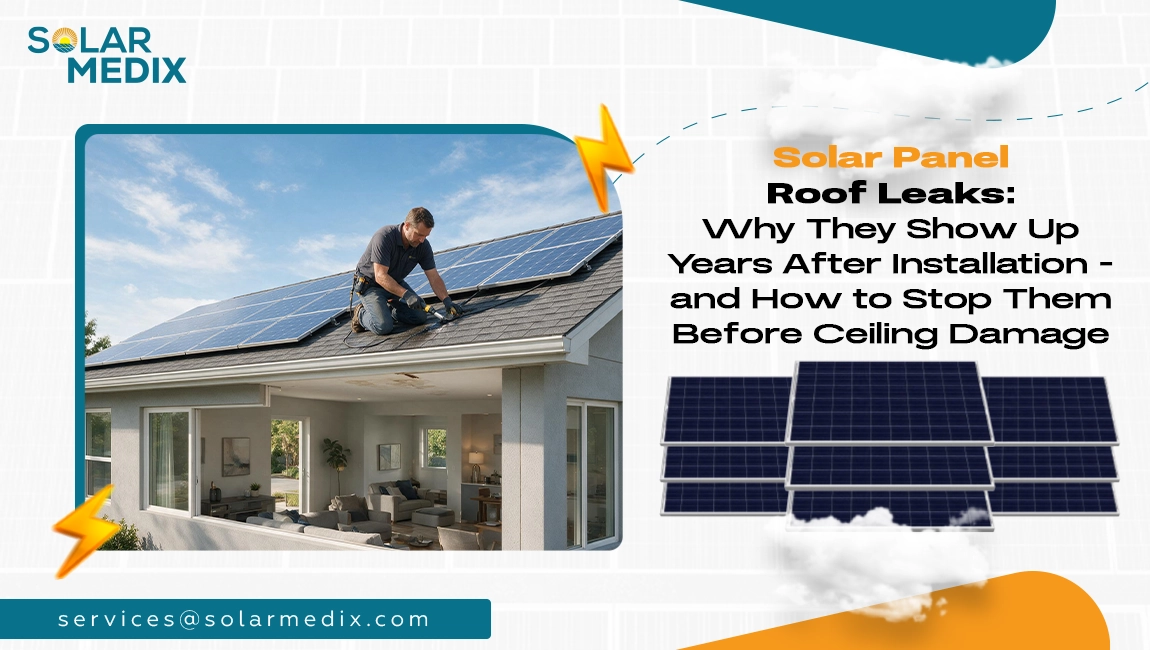
Solar panels themselves almost never leak — the risk comes from mounting points, roof penetrations, and flashing that anchor the array. These seals degrade over time from UV exposure, temperature swings, and freeze-thaw cycles, which is why leaks so often surface 5–10 years after installation, frequently right after a summer storm. If you see a water stain near your solar array, it needs a professional inspection — not a wait-and-see approach.
You invested in solar panels expecting decades of reliable, lower-cost energy. But years after installation, your roof can develop problems around the mounting points, even when the panels themselves are working perfectly.
Solar panel roof leaks often appear years after installation because roofing materials, seals, flashing, and mounting points can deteriorate over time. A heavy rainstorm may be the first time you notice a water stain, but the underlying problem can have been developing for months or years.
At Solar Medix, we regularly help homeowners determine whether a leak is actually coming from the solar installation or another part of the roof. Understanding how solar panel roof leaks develop can help you catch problems earlier and avoid costly damage to your ceiling, insulation, and roof structure.
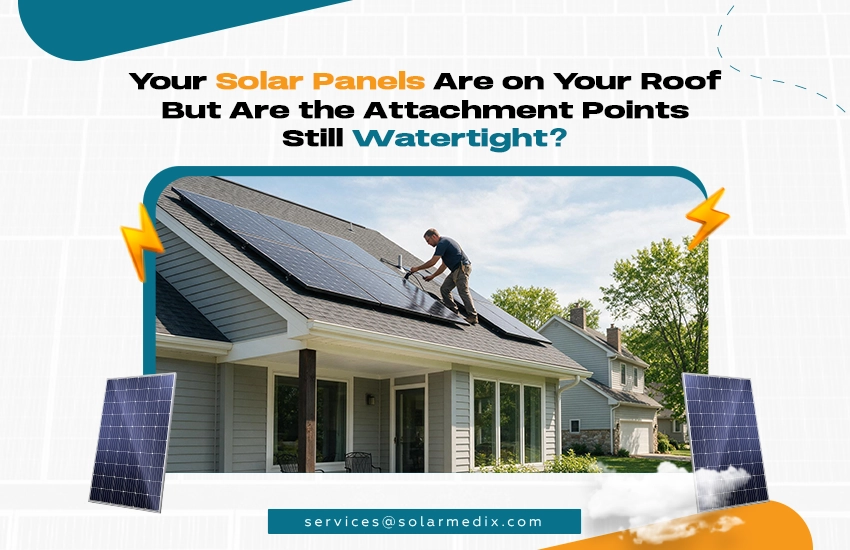
Your Solar Panels Are on Your Roof — But Are the Attachment Points Still Watertight?
Not necessarily. Solar panels can remain fully functional while the attachment points, flashing, or roof seals around the mounting hardware deteriorate and allow water to enter. Over time, weather exposure, aging sealants, roof movement, or improper installation can compromise these points and lead to solar panel roof leaks.
Can Solar Panel Roof Leaks Be Caused by Solar Installations?
Yes, solar panel installations can contribute to roof leaks, but the panels themselves are not usually the source. The risk comes from the mounting hardware and roof penetrations used to secure the system. If flashing, seals, or installation materials fail over time, water can enter around the attachment points. Panels can also conceal a slow leak, allowing roof damage to develop before you notice water inside your home.
The Real Leak Risk: Mounting Points, Flashing & Roof Penetrations
To secure your racking system, installers must drill lag bolts directly into your roof rafters. Each of these penetrations is a potential leak point. To make them watertight, professional installers use metal flashing that slides up under the shingles, paired with heavy-duty rubber collars (often EPDM) and industrial-grade sealants.
If any part of this three-layered defense (flashing, rubber collar, sealant) fails, water will seep down the bolt thread and right into your attic:
| Defense Layer | Material Typically Used | Primary Vulnerability |
| Primary Shield | Metal Flashing (Aluminum/Steel) | Rust, improper sliding under shingles, buckling |
| Secondary Gasket | EPDM Rubber Collar / Boot | Dry-rotting, cracking from UV rays |
| Tertiary Seal | Industrial Solar Sealant / Caulk | Drying out, peeling, structural movement |
Why Solar Roof Leaks Don’t Show Up Right Away
If a leak were caused by an installer missing a rafter entirely during installation, you would likely notice it during the very first rainstorm of the season. When a leak shows up 5, 8, or 10 years later, it is almost always due to material fatigue. Over a decade, the materials holding back the elements wear out, slowly transforming a microscopic gap into an active leak.
How UV Exposure, Temperature Swings & Freeze-Thaw Cycles Degrade Solar Mounts
UV exposure, temperature swings, and freeze-thaw cycles can gradually weaken solar mounting components, seals, and flashing, increasing the risk of water intrusion and solar panel roof leaks. In the Northeast, these materials must withstand intense sun, summer heat, freezing temperatures, snow, ice, and repeated expansion and contraction. Over time, that stress can cause seals to crack, loosen, or deteriorate around mounting points.
- Intense UV Radiation: Solar sealants and rubber boot flashing bake in the sun. Over time, UV rays dry out rubber and cheap sealants, causing them to crack, shrink, and crumble.
- Thermal Expansion & Contraction: As the sun heats your panels and racking, the metal expands. At night, it contracts. This constant micro-movement puts physical stress on the sealants surrounding the lag bolts.
- The Freeze-Thaw Cycle: In NY and NJ winters, water gets trapped in small crevices around the mounts. When it freezes, it expands, widening the gaps. When it thaws, the water pushes deeper into your roof deck.
Why Summer Storms Are When NJ & NY Homeowners Discover Leaks
In the Northeast, spring and summer bring torrential downpours and severe thunderstorms. After months of gradual winter degradation, a fast-moving summer storm can dump inches of rain in minutes, overwhelming damaged or degraded flashing and exposing solar panel roof leaks that may have been developing for months.
What’s the Difference Between a Panel Problem and a Mounting Problem?
A panel problem affects your system’s electrical production (e.g., micro-cracks in the glass, failed bypass diodes, or inverter issues). A mounting problem is structural and physical, directly threatening the weatherproofing of your home. While a panel problem hurts your wallet via reduced power output, a mounting leak actively threatens your home’s structural integrity.

You Found a Water Stain Near Your Solar Array — What Does It Mean?
An active stain on your drywall is a late-stage warning sign of a water intrusion that has likely been developing for months.
Early Warning Signs of a Solar Roof Leak (Before It Reaches Your Ceiling)
Early warning signs of a solar roof leak include attic discoloration, unexplained dampness, reduced home energy efficiency, and algae or moss developing around or below solar mounting points. These signs can appear before water reaches your ceiling, giving you an opportunity to investigate the leak before it causes more serious structural or interior damage.
Water Stains, Musty Smells & Peeling Paint: What Each One Signals
Brown or yellow ceiling stains usually indicate water intrusion, musty smells can signal trapped moisture and mould growth, and peeling or bubbling paint often means water is accumulating behind the surface. These signs suggest the leak has progressed beyond the roof and may already be affecting your home’s interior.
Is a Solar Roof Leak an Emergency? When to Act Fast
Yes. While it may start as a slow drip, a roof leak under solar panels is an urgent issue. Left unaddressed, water will rot your structural roof deck, ruin your attic insulation, destroy your sheetrock, and create a breeding ground for toxic mold.
What Happens If You Ignore a Leak Around Solar Panels?
It can travel down a rafter and pool above a ceiling yards away, or run down inside an exterior wall, ruining your home’s structural framing and framing-attached wiring.
Can Water Damage Solar Wiring and Electrical Components?
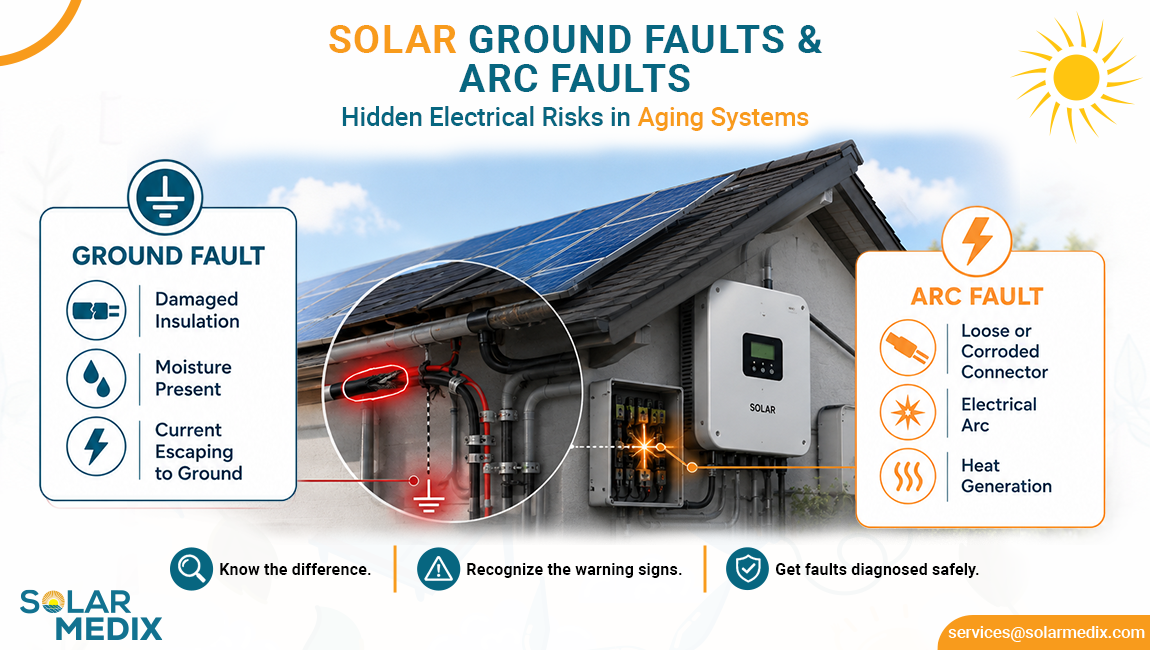
Yes. While solar wiring and junction boxes are rated for outdoor use, they are not designed to be submerged or subjected to constant, channeled water streams. According to Federal Emergency Management Agency (FEMA) guidelines, unchecked water damage on building structures can facilitate rapid mold growth within 24 to 48 hours and deteriorate nearby electrical runs. Corrosion in your solar connections can lead to system faults, ground faults, and, in worst-case scenarios, serious electrical fire hazards.
What Does Active Dripping vs. Old Staining Tell You?
An active drip means the sealing barrier has completely failed, and water is actively penetrating. An old, dry stain might suggest a leak that only triggers when wind-driven rain hits the roof from a highly specific angle. However, “dry” stains should never be ignored; the next storm can easily reactivate them.

Do the Panels Have to Come Off to Fix the Leak? What Professional Repair Actually Involves
Not always, but fixing a solar roof leak often requires temporarily removing or lifting affected panels to access the mounting points, flashing, and roofing beneath them. A professional repair combines roofing work with solar electrical safety to identify the leak source, repair the roof or mounting hardware, and safely restore the panels.
Do All Panels Have to Be Removed to Fix a Solar Roof Leak?
No. We do not need to strip your entire roof to fix a single leak point. However, to access the failed flashing or mounting bracket, we do have to safely remove the specific solar panels directly overlaying the leak site. For comprehensive safety, read more about how our specialists execute this in our Solar Removal & Reinstallation Guide.
What Does a Solar Roof Leak Inspection Actually Include?
A professional inspection typically begins with an attic crawl, where safely accessible, to trace the path of water from inside the roof. This is followed by a physical on-roof inspection of the solar racking, mounting brackets, flashing, and surrounding shingles to identify any points where water may be entering. The inspection also includes electrical testing to check for ground faults, which can indicate that water has reached live wiring or other electrical components.
How Technicians Locate the Exact Source of a Solar Flashing Leak
Water is tricky; where it drips is rarely where it enters. Our technicians use a mix of infrared thermal imaging, moisture meters, and highly controlled water-isolation tests to trace the exact pathway the water is taking from the roof’s exterior down to your ceiling.
Resealing vs. Full Flashing Replacement — How Technicians Decide
Technicians choose between resealing and full flashing replacement based on the condition of the existing flashing and seals. If the flashing is still structurally sound but the sealant has deteriorated, resealing with a suitable UV-resistant sealant may be enough. If the flashing is rusted, damaged, buckled, or the rubber boot has deteriorated, the mounting hardware and flashing may need to be replaced, along with any affected roofing materials.
Can a Roofer Fix a Solar Roof Leak, or Do You Need a Solar Specialist?
You should always hire a certified solar specialist. Standard roofing companies do not have the licensing, training, or equipment to safely disconnect, handle, and store high-voltage DC solar panels. If a standard roofer damages your array, breaks a module, or improperly reconnects your wiring, they will likely void your solar equipment warranties.
To protect your home and your investment, you need a team cross-trained in both roofing mechanics and solar electrical systems.
Will Fixing the Leak Affect My Solar Warranty?
If you use a certified, fully insured solar specialist like Solar Medix, your manufacturer and production warranties will remain fully intact. We document the process meticulously so you can prove the system was handled by qualified hands.
Can Solar Medix Fix a Roof Leak on a System They Didn’t Install?
Yes. Roughly half of our daily service calls are from homeowners whose original solar installers have gone out of business, left the state, or simply won’t return their calls. We service, repair, and seal systems regardless of who originally put them on your roof.
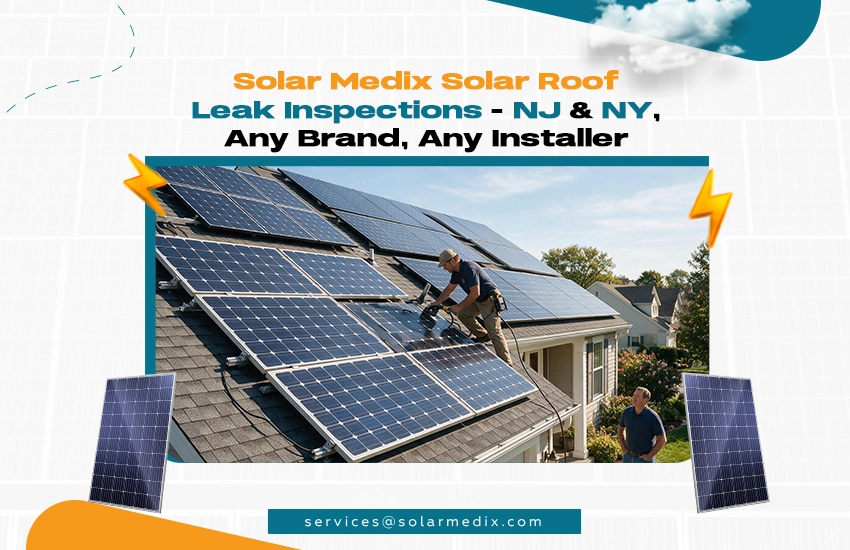
Solar Medix Solar Roof Leak Inspections — NJ & NY, Any Brand, Any Installer
Solar Medix provides solar roof leak inspections across NJ and NY for any solar brand or installer. Our team combines solar diagnostics and roofing expertise to identify the source of leaks, assess the damage, and help protect both your roof and solar system.
What Solar Medix’s Roof Leak Inspection Covers
A Solar Medix roof leak inspection covers the suspected leak area, the roof structure beneath the solar system, and the electrical safety of the affected solar components. Our comprehensive diagnostic process leaves no stone unturned. We perform visual and thermal diagnostics of the suspected leak area to identify signs of moisture intrusion, inspect the rafters directly beneath the solar mounts for any structural damage, and carry out electrical health and safety checks on the affected portion of the solar array to ensure it is operating safely.
How We Find the Source, Reseal the Mount, and Reinstall Only What’s Needed
We believe in precise, honest repairs. Instead of recommending a massive, unnecessary teardown, we pinpoint the exact bracket or shingle causing the issue. We safely de-energize and remove only the panels blocking our access, replace the faulty flashing with premium materials, reseal the mount with commercial-grade polymer sealants, and reinstall the panels to peak operating standards.
Protecting Both Your Roof and Your Solar System in One Visit
You don’t have to coordinate between a roofing contractor who doesn’t understand solar and a solar company that doesn’t do roof work. Our cross-trained crews resolve the entire issue in a single, streamlined visit.
How Quickly Can Solar Medix Respond After a Storm?
Because summer storms can cause sudden, high-stress situations for homeowners, we prioritize active roof leak calls to minimize interior drywall damage. We serve our local communities across New Jersey and New York swiftly to get your home dry and your system running.
Serving NJ & NY Homeowners — Any Brand, Any Installer
We service all major residential solar systems, including a wide range of solar panel brands, racking systems, string inverters, microinverters, and optimizers. Whether your system is a few years old or over a decade old, our experienced technicians know how to inspect, diagnose, maintain, and repair it.
Even if your original installer is no longer in business or doesn’t offer service anymore, you don’t have to worry. Your roof, your solar system, and your investment are in safe, experienced hands with Solar Medix.
Prevent Ceiling Damage Now
A water stain near your solar array won’t fix itself, and the longer you wait, the more expensive the damage gets. Solar Medix pinpoints the source, seals it properly, and protects both your roof and your system, regardless of who installed it.
FAQs
What are the early warning signs of a solar roof leak?
Watch for ceiling discoloration near your array, damp smells in your attic, bubbling paint, or concentrated organic growth on your roof below the panels.
Is a solar roof leak an emergency?
Yes. Constant moisture rotting your attic rafters or ceiling drywall leads to rapid mold growth and can compromise your home’s structural integrity.
Do the panels have to be removed to fix the leak?
We do not have to remove the entire system. We only remove the specific panels directly blocking access to the damaged bracket or flashing.
What does a professional solar roof leak inspection involve?
It includes tracing the leak paths internally through the attic, conducting visual and physical roof-surface checks, and running thermal imaging and electrical safety diagnostics.
Can a roofer fix a solar roof leak or do I need a solar specialist?
You need a solar specialist. Roofers do not have the specialized tools, training, or licensing to safely handle high-voltage solar components, and hiring them may void your system’s warranty.