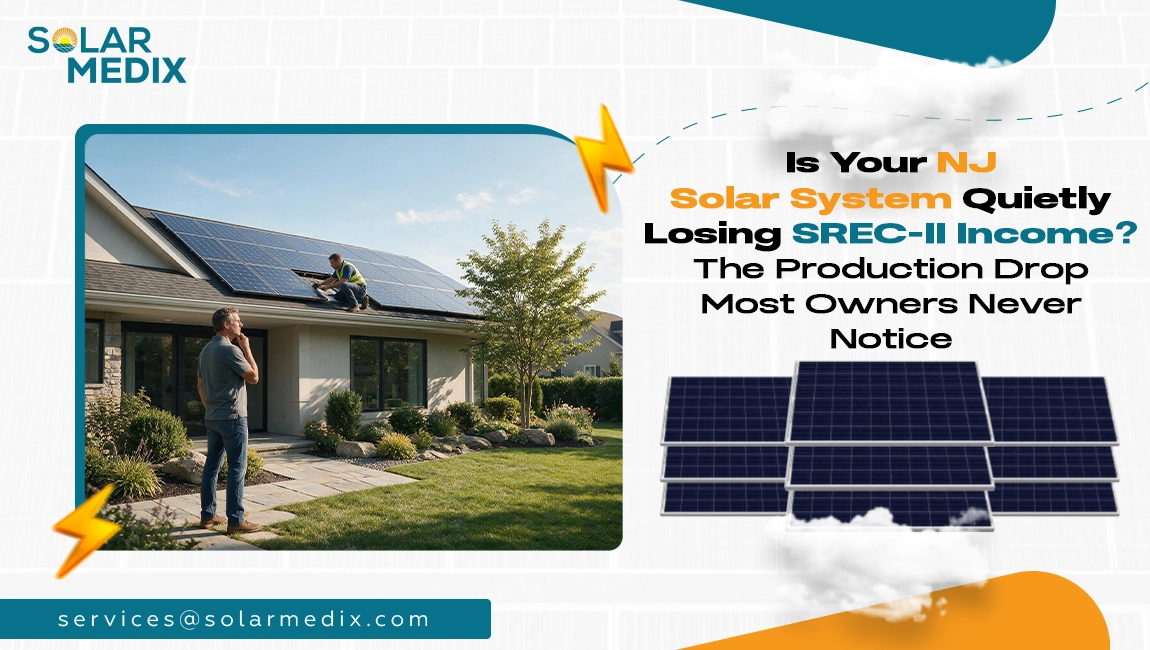
NJ solar system underperformance can directly reduce your SREC-II income because your incentives depend on how much electricity your system produces. Even an 8–15% production drop from dirt, shading, equipment issues, or panel degradation can mean fewer incentives and net metering credits. Solar Medix helps identify hidden production losses and restore system performance so you can protect your energy savings and SREC-II earnings.
One of the biggest misconceptions among New Jersey solar owners is believing that a solar system either works or it doesn’t. In reality, NJ solar system underperformance often happens gradually, with systems continuing to generate electricity while producing less than they should.
That gradual decline is easy to overlook because it happens little by little. A few per cent this year, a little more next year, and eventually a meaningful amount of energy production can be lost without any obvious system failure.
The impact isn’t just higher electricity costs. Lower production can also mean smaller quarterly SREC-II payments, reduced net metering credits, and lower overall returns from your solar investment.
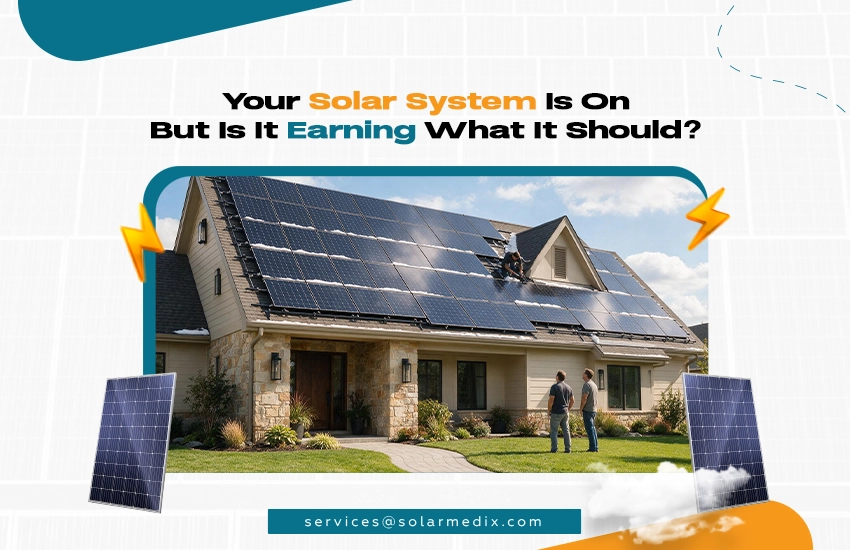
Your Solar System Is On — But Is It Earning What It Should?
Many homeowners assume that if their inverter is running and their lights stay on, their solar system is performing exactly as it should. Unfortunately, that’s not how solar performance works. Your system can quietly lose production for months—or even years—without triggering an obvious warning. Every kilowatt-hour your system fails to generate means less clean energy, fewer savings on your electric bill, and lower SREC-II income. Understanding how these incentives work is the first step toward protecting your investment.
How Does New Jersey’s SREC-II Program Actually Pay You?
New Jersey’s SREC-II program pays you based on your solar system’s electricity production: each 1 MWh generated earns an incentive payment at your approved ADI rate. Through the ADI program, eligible residential systems receive payments based on measured production. More production means more SREC-II income; lower production means lower payments.
What Is the SuSI/ADI Track and What Rate Am I Getting?
The SuSI/ADI Track is New Jersey’s current solar incentive program, and most residential homeowners receive a fixed ADI payment rate for each megawatt-hour their system generates over a 15-year incentive period. The Successor Solar Incentive (SuSI) Program replaced New Jersey’s original SREC program for newer solar installations. Most residential homeowners participate through the Administratively Determined Incentive (ADI) program, which provides a set financial incentive based on solar energy production.
For many residential systems, the ADI incentive rate is approximately $76.50 per MWh. However, your exact rate depends on factors such as when your system was approved, the incentive schedule available at that time, your project type, and whether your system met the program’s eligibility requirements.
Unlike electricity prices, your ADI incentive rate is generally fixed once your project is accepted into the program. The amount you receive can change because it depends on how much electricity your system produces each quarter. This is why maintaining strong system performance is important, as higher energy production leads to higher incentive payments over the life of the program.
How Net Metering and SREC-II Work Together (And Why Both Depend on Production)
Net metering and SREC-II are separate benefits, but both are affected by how much electricity your solar system produces. Net metering can reduce your electricity costs by crediting excess solar energy sent to the grid, while SREC-II provides incentive payments based on your system’s production. When NJ solar system underperforms, reducing production, you can receive fewer net metering credits and smaller SREC-II payments.
That means one system issue can affect your finances in two ways: you may buy more electricity from the utility while also earning less from SREC-II.
What Does NJ Solar System Underperformance Actually Mean?
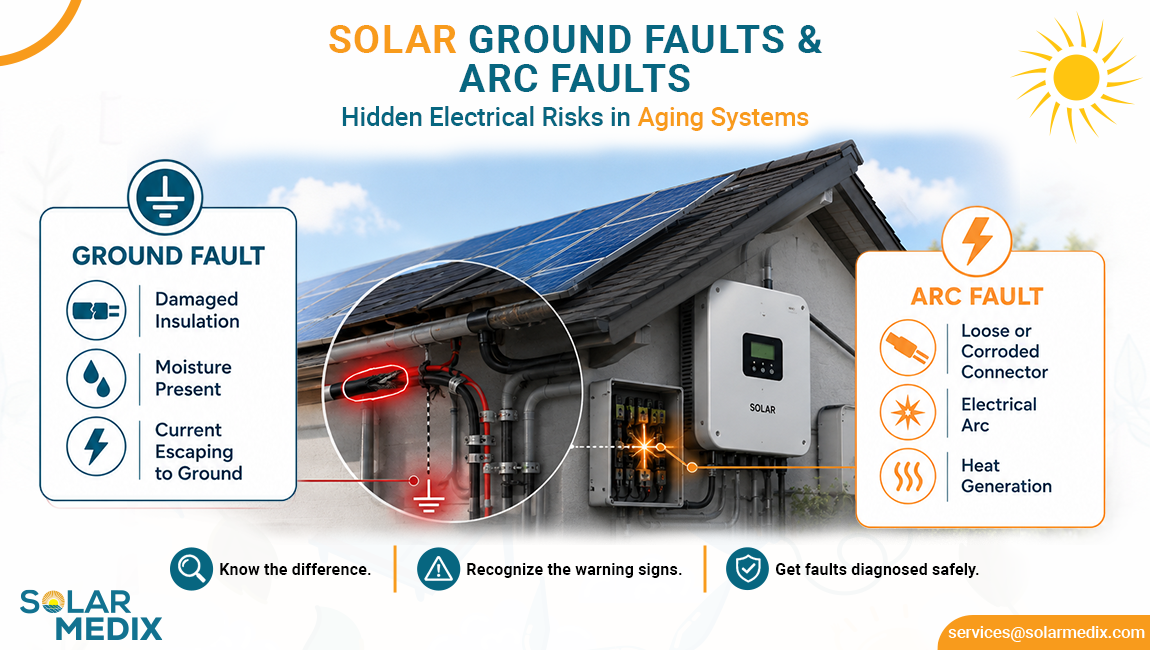
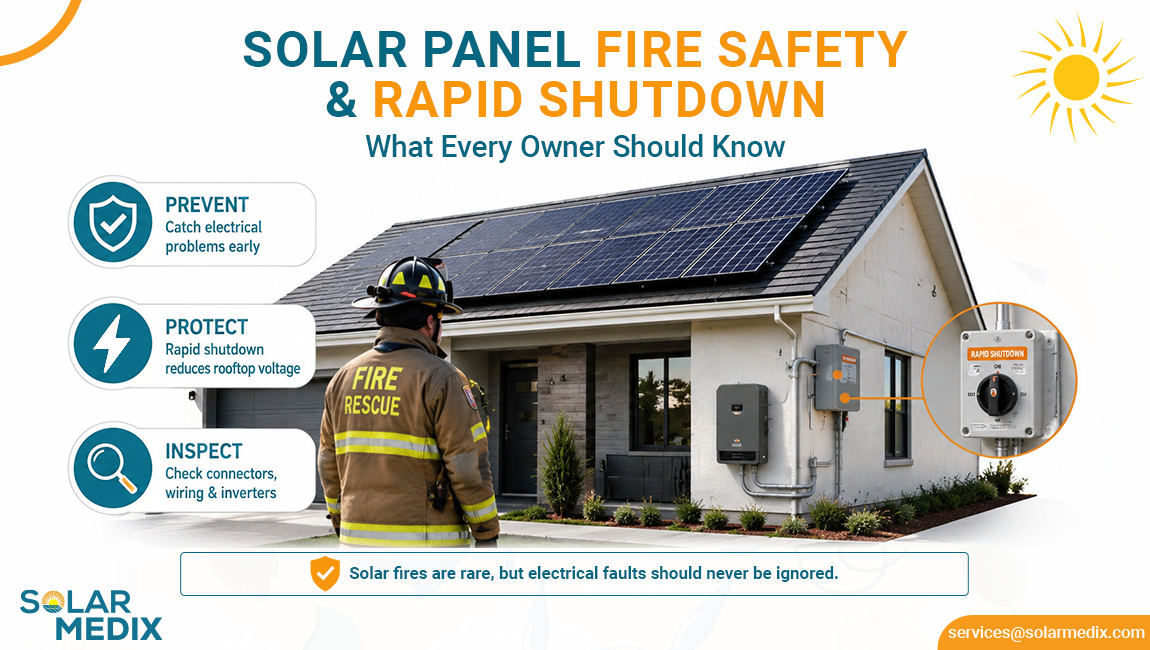
NJ solar system underperformance means your solar system is producing less electricity than it reasonably should under current conditions. Some production loss is normal as panels age, but issues such as shading, dirt buildup, equipment faults, wiring problems, weather damage, or monitoring failures can reduce output faster than expected. These problems often develop gradually, so your system may keep producing electricity without making the loss obvious.
At Solar Medix, production diagnostics help identify these hidden losses before they lead to prolonged reductions in energy production and SREC-II income.
Why Most NJ Solar Owners Never Notice a 10% Output Drop
NJ solar system underperformance is often hard to notice because production usually declines gradually rather than stopping suddenly. A small monthly drop can easily be hidden by seasonal weather, changing utility bills, and the fact that many homeowners stop checking their monitoring portal after the first year. An app showing that your system is “online” also does not necessarily mean it is producing at its expected level.
By the time the decline becomes obvious, your system may have been underperforming for months or even years.
What Is Normal Solar Degradation — And What Is a Problem?
Normal solar degradation is typically a gradual 0.3%–0.8% annual decline in panel output, while a larger or sudden drop may indicate a system problem. Panels naturally lose some efficiency as they age, but production declines beyond expected levels can point to issues such as dirt buildup, shading, inverter faults, or other equipment problems. Solar Medix compares your actual production with expected output based on your system’s age, location, weather, and performance history to determine whether the decline is normal or needs investigation.
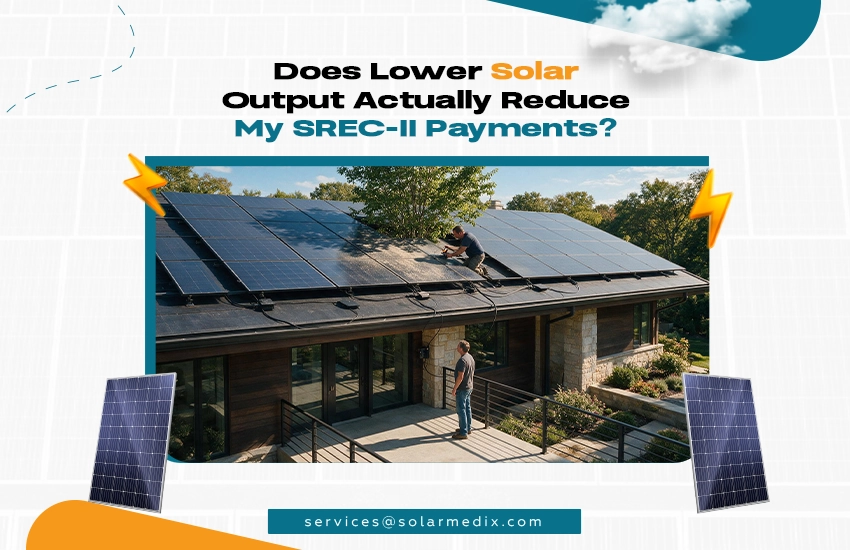
Does Lower Solar Output Actually Reduce My SREC-II Payments?
Many New Jersey homeowners know they receive SREC-II payments, but few realise those payments depend entirely on how much electricity their system produces. Even if your panels still generate power every day, gradual production losses can quietly reduce both your quarterly SREC-II checks and your annual savings. Let’s break down exactly how it happens and what it could be costing you.
How Production Loss Hits Your SREC-II Check
Your SREC-II payments aren’t based on how expensive your solar system was or how many panels you installed. They’re based solely on the electricity your system actually produces. Every kilowatt-hour your panels fail to generate is energy that can’t count toward your SREC-II incentive.
For example:
| Annual Production | Approximate SREC-II Earnings* |
| 10 MWh | $765 |
| 9 MWh | $688.50 |
| 8 MWh | $612 |
*Based on an ADI incentive rate of approximately $76.50 per MWh.
That might not seem like a huge difference after one year. However, remember that most homeowners remain in the SREC-II program for 15 years. A small production loss today can quietly become thousands of dollars in missed incentive payments over the lifetime of your system. At Solar Medix, one of the first things we check during a production evaluation is whether your current energy generation still matches what your system should be producing.
How Much Is Lost Output Actually Worth in New Jersey?
Lost solar production in New Jersey can reduce your SREC-II income while also increasing electricity costs by lowering your home’s energy generation and net metering credits, causing you to rely more on utility power.
Let’s look at an example.
| If Your System Loses… | Annual Energy Lost | Approximate SREC-II Loss | Additional Utility Cost* |
| 5% | 500 kWh | ~$38 | ~$116 |
| 10% | 1,000 kWh | ~$76.50 | ~$232 |
| 15% | 1,500 kWh | ~$115 | ~$348 |
*Using New Jersey’s approximate residential electricity rate of 23.2¢/kWh.
That means a seemingly “small” production decline could cost hundreds of dollars every year—and considerably more over the life of your system.
The Hidden Math: Soiling + Shading + Degradation = Lost Income Over Years
Production losses are often caused by multiple small issues rather than one major failure. Dirt buildup, growing shade, natural panel aging, and inverter performance issues may each cause minor reductions, but together they can significantly lower your system’s overall output.
| Issue | Typical Production Loss |
| Dirt & debris | 2–7% |
| Partial shading | 5–25% |
| Natural panel degradation | 0.3–0.8% per year |
| Equipment issues | Varies significantly |
Because these losses happen gradually, most homeowners never notice until they compare several years of production data.
That’s why Solar Medix recommends routine performance evaluations instead of waiting for an error message that may never appear.
How to Tell If Your System Is Underperforming: Month-by-Month Comparison Guide
One of the easiest ways to identify NJ solar system underperformance is by comparing this year’s production with the same months from your first full year of operation. Don’t compare July with January. Instead, compare July this year with July from previous years, then do the same for August, September, and other matching months. Weather changes from year to year, but consistent declines across multiple months can point to an underlying performance issue.
| Month | First Full Year | Current Year | Difference |
| April | 820 kWh | 760 kWh | -7% |
| May | 940 kWh | 865 kWh | -8% |
| June | 1,010 kWh | 925 kWh | -8.4% |
If you notice similar declines over several months, it’s worth having your system professionally evaluated.
What Causes Solar Output to Drop Quietly Over Time?
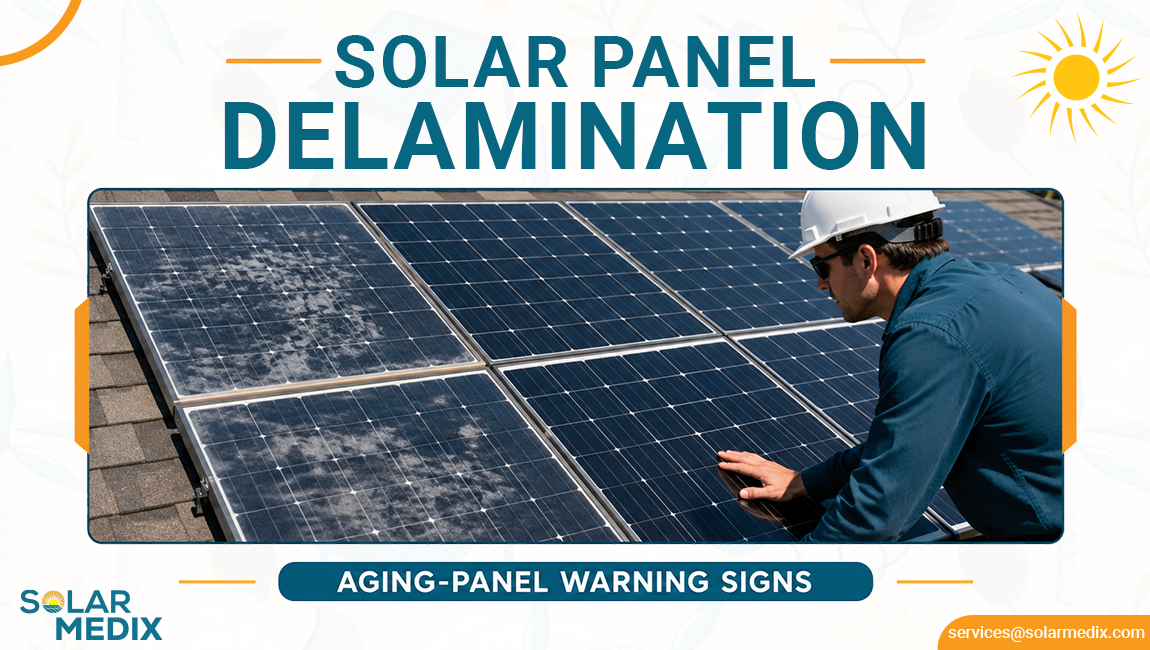
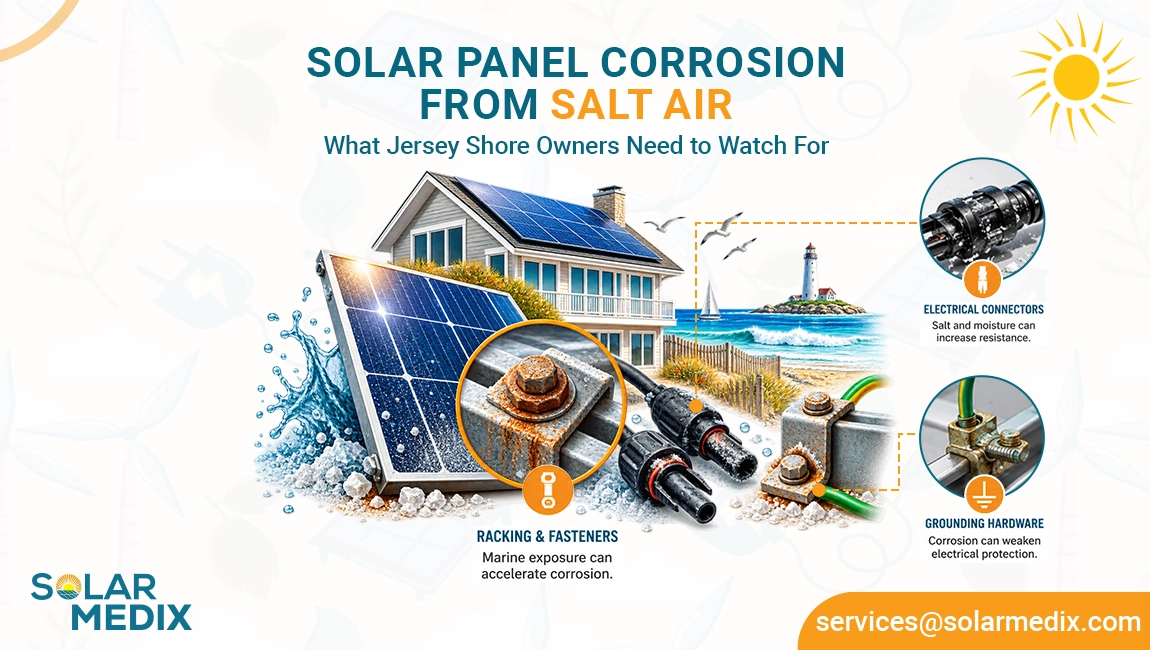
Solar output often drops quietly over time due to issues like dirt buildup, shading, equipment aging, electrical faults, storm damage, moisture, damaged components, or inaccurate monitoring that may require professional diagnostics to detect. That’s why preventative maintenance is often much less expensive than allowing reduced production to continue for years. If your panels haven’t been cleaned in years, consider scheduling Solar Panel Cleaning. Even a modest improvement in production can increase both your energy savings and SREC-II earnings.
Are SREC-II Payments Taxable? What NJ Owners Should Know
SREC-II payments may be taxable, but the tax treatment depends on your individual circumstances and applicable federal and New Jersey tax rules. Tax treatment can vary, so homeowners should consult a qualified tax professional before filing. Regardless of how your payments are taxed, maintaining strong solar production helps you avoid losing potential SREC-II income.
How Do I Know If My NJ System Is Losing SREC-II Income — And What Fixes It?
If you’ve started wondering whether your solar system is producing as much energy as it should, you’re already asking the right question. The next step is figuring out why production has dropped and whether it’s something that can be fixed. Many performance issues are completely repairable when caught early. At Solar Medix, we help homeowners identify hidden production losses, pinpoint the root cause, and restore their systems to peak performance.
How to Compare Your Current Output Against Your First Full Year
One of the most reliable ways to spot underperformance is by comparing your current production with your system’s first full year of operation. Why the first full year? Because that’s when your panels were new, your equipment was operating at full capacity, and you had a solid baseline for expected performance.
Follow these simple steps:
- Download your production reports from your monitoring portal.
- Compare the same month across different years (June vs. June, not June vs. December).
- Account for significant weather differences if applicable.
- Look for consistent production declines over multiple months.
- Pay attention to drops that continue year after year.
If you’re unsure how to interpret your monitoring data, Solar Medix can review your historical production and determine whether your system is performing as expected.
What a Sustained 8%+ Gap in Production Usually Means
A sustained 8% or greater production gap usually indicates a system performance issue rather than normal solar degradation and should be investigated. Solar panels naturally lose a small amount of efficiency each year, but a consistent drop of 8% or more over several months often points to issues such as dirt buildup, new shading, inverter problems, faulty optimisers or microinverters, electrical faults, damaged modules, or animal-related wiring damage.
Weather changes can temporarily affect output, but they typically do not explain a long-term decline. Solar Medix evaluates production by comparing historical performance, local weather conditions, system age, equipment specifications, and expected output for your New Jersey location to determine whether the issue is normal variation or a repairable problem.
Soiling vs. Shading vs. Inverter Fault: How to Tell the Difference
Soiling, shading, and inverter faults can all reduce solar production, but they affect your system in different ways and require different solutions.
| Issue | Common Signs | Typical Solution |
| Soiling | Gradual decline across the entire system | Professional solar panel cleaning |
| Shading | Lower production during certain times of day | Tree trimming or panel optimization |
| Inverter Fault | Sudden production drop or error messages | Equipment inspection or repair |
| Optimizer/Microinverter Failure | One section of panels underperforming | Component replacement |
| Electrical Issue | Inconsistent or unexplained production | Electrical diagnostics |
Without professional testing, many of these issues look identical in a homeowner’s monitoring app. That’s why Solar Medix performs a complete production assessment instead of relying solely on monitoring data.
Does Cleaning Solar Panels Actually Improve SREC-II Earnings?
Yes, cleaning solar panels can improve SREC-II earnings when dirt or other buildup is reducing energy production. Less sunlight reaching the panels means less electricity generated, which can reduce both SREC-II payments and net metering credits. Cleaning can help recover lost production, particularly when significant buildup is present.
What Does a Professional Production & Performance Diagnostic Include?
A professional production and performance diagnostic identifies hidden issues affecting your solar system’s energy output, efficiency, and SREC-II earnings. A comprehensive diagnostic goes beyond checking whether the inverter is running. At Solar Medix, our Production & Performance Check may include historical production analysis, monitoring data review, physical panel inspection, shading assessment, inverter testing, electrical connection checks, wiring evaluation, equipment health assessment, performance benchmarking, and recommendations for repairs or maintenance.
Instead of guessing what is wrong, you receive a clear understanding of your system’s current performance and the steps needed to improve production if issues are found.
Can Solar Medix Service My System Even If They Didn’t Install It?
Yes. One of the biggest misconceptions homeowners have is that they must go back to the original installer for service. That’s not the case. Solar Medix specialises in servicing existing residential solar systems, including systems installed by other companies.
Whether your installer is no longer in business, does not offer maintenance, is not responding to service requests, or installed your system years ago, our experienced technicians can inspect, diagnose, maintain, and repair many major solar brands.
With more than 17 years of field experience and thousands of completed projects, Solar Medix helps homeowners across New Jersey protect the performance of the systems they already own.
What Is the ROI of a Maintenance Visit vs. Years of Lost SREC-II Income?
A maintenance visit is worth the cost when it finds and fixes a production problem before it causes years of lost SREC-II income and higher electricity costs. The ROI depends on the issue found, the cost of the visit and how much production the problem is costing you. A small repair that restores significant lost production can pay for itself quickly, while leaving the issue unresolved can continue reducing SREC-II payments, net metering credits and overall solar savings.
Solar Medix: NJ’s Production & Performance Specialists — for Any System, Any Installer
Even a modest production decline can quietly reduce your SREC-II income, increase your electric bills, and lower your overall return on investment. The next step is finding out exactly how your system is performing—and fixing any issues before another quarterly SREC-II payment is affected. That’s where Solar Medix comes in.
What Solar Medix’s Production & Performance Check Includes
At Solar Medix, we don’t just check whether your system is online. We evaluate whether it is producing the energy it was designed to generate. Our Production & Performance Check is designed to uncover hidden issues that may be reducing your solar output and SREC-II earnings.
Depending on your system, your inspection may include historical production analysis, monitoring data review, expected versus actual production comparison, inverter health assessment, panel condition inspection, shading analysis, electrical connection testing, wiring inspection, optimizer or microinverter evaluation, and recommendations for repairs or maintenance.
Every inspection is focused on one goal: helping you recover lost production and maximise the value of your solar investment.
How We Benchmark Your Output Against Expected NJ Production
We identify NJ solar system underperformance by comparing your actual production with expected output for your system, location, age, equipment, and weather conditions. Solar Medix reviews your first full year of production, local New Jersey weather, seasonal sunlight, panel orientation, roof angle, equipment specifications, and manufacturer performance expectations.
This helps determine whether your production loss is normal, temporary, or a sign of an ongoing issue that may be fixable.
What Happens After We Find the Problem: Repair, Clean, Restore
Finding the problem is only the beginning. Once we’ve identified what’s affecting your system, we’ll recommend the most effective solution based on your equipment, production history, and long-term goals. That could include professional solar panel cleaning, inverter repairs or replacement, optimizer or microinverter replacement, electrical repairs, wiring corrections, shading recommendations, ongoing maintenance, or performance monitoring. Our goal is to restore your system’s performance so it produces as much clean energy and financial value as possible.
Serving Solar Owners Across New Jersey — Any Brand, Any Installer
You don’t have to be a previous Solar Medix customer for us to help. We regularly service systems installed by other contractors, including homeowners whose original installer has gone out of business, no longer offers maintenance, does not respond to service requests, or installed the system years ago.
Whether your system uses string inverters, microinverters, or power optimizers, our technicians have experience diagnosing and servicing a wide range of residential solar systems.
Solar Medix proudly serves homeowners throughout New Jersey and also provides solar services in New York and Texas.
How to Book a Production Check Before Your Next Quarterly SREC-II Payment
Every quarter your system underperforms is another quarter of reduced earnings. The sooner you identify hidden production losses, the sooner you can start recovering the energy and income you have been missing. Booking a Production & Performance Check with Solar Medix is simple. We review your system’s production history, compare your output with expected performance, identify hidden losses, explain the cause of the issue, recommend cost-effective solutions, and help restore your system’s efficiency. Whether your goal is maximizing SREC-II payments, lowering electric bills, or extending the life of your solar investment, we’re here to help.
Don’t Let Hidden Production Loss Steal Your Solar Savings
Even a small decline in production can reduce your quarterly SREC-II payments, shrink your net metering credits, and increase your electricity costs year after year. The frustrating part is that many homeowners don’t realize it’s happening until they’ve already missed out on months—or even years—of potential savings.
At Solar Medix, we believe you deserve to know exactly how your system is performing. Our experienced team benchmarks your system against expected New Jersey production, identifies hidden performance issues, and recommends the right solution to restore output.
The sooner you catch an issue, the sooner you can get your production—and your earnings—back where they belong.
Frequently Asked Questions
How does New Jersey’s SREC-II program pay solar owners?
The SREC-II program pays eligible solar owners based on the amount of electricity their system produces. For many residential systems in the ADI program, homeowners earn approximately $76.50 per megawatt-hour (MWh) generated for up to 15 years. The more electricity your system produces, the larger your quarterly incentive payments.
Does lower solar output actually reduce my SREC-II payments?
Yes. Since SREC-II payments are based on actual electricity production, any reduction in solar output directly lowers the amount you earn. Even gradual production losses caused by dirt, shading, or equipment issues can reduce your quarterly payments.
How much is lost solar output worth in New Jersey?
The financial impact depends on how much production your system loses. A 10% drop in output doesn’t just reduce your SREC-II earnings—it also means fewer net metering credits and higher electricity purchases from your utility, increasing your overall annual costs.
How would I know if my system is quietly underperforming?
Compare your current monthly production with the same months from your first full year of operation. If you notice a consistent decline of 8% or more over several months, it’s a good idea to have your system professionally evaluated.
What causes solar output to drop gradually over time?
Common causes include dirty panels, tree growth creating shade, inverter issues, damaged wiring, aging equipment, faulty optimizers, bird activity, and natural panel degradation. Many of these issues develop slowly and don’t trigger warning messages.